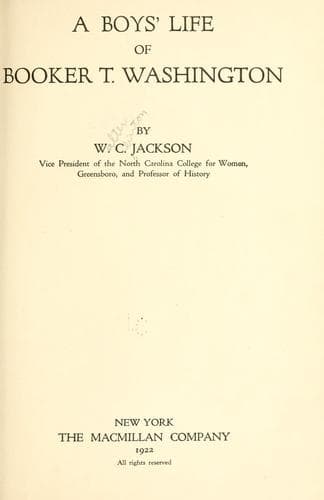
A boys' life of Booker T. WashingtonJackson, Walter Clinton
History
A boys' life of Booker T. Washington
Jackson, Walter Clinton
African American educators -- Biography -- Juvenile literature; Washington, Booker T., 1856-1915 -- Juvenile literature
Washington was married three times. His first wife, as stated in a
previous chapter, was Fannie M. Smith, of Malden, who died in 1884,
leaving a daughter, Portia. The second marriage was to Olivia Davidson,
who had been a teacher at Tuskegee from its beginning. She had been of
wonderful assistance to Washington in the early days of Tuskegee. She
was the mother of the two boys, Booker, Jr., and Davidson. His third
marriage was to Margaret Murray, of Mississippi, a graduate of Fisk
University and for several years a teacher at Tuskegee. This marriage
occurred in 1892. Mrs. Washington has had a very useful and
distinguished career. No woman of her race has helped her people so much
in recent years. She will be remembered not merely as the wife of Booker
Washington, but for her own remarkable service to her people.
[Illustration:
BOOKER T. WASHINGTON AND HIS FAMILY
]
Washington was a man of unusual personal appearance. From the
description that James Creelman gave of him on the occasion of his
famous speech in Atlanta, it can readily be seen that he was a man of
commanding and striking personality. Wherever he went he attracted
attention.
He was an untiring worker. He went at tremendous speed all the time. He
could do as much, as a rule, as three or four ordinary men. He kept a
stenographer with him all the time. As he went about the grounds he
would dictate suggestions and ideas for changes and improvements. He
would often awaken his stenographer at night to dictate a letter or a
speech or a statement for the papers. In this way he never overlooked an
important thought or idea that occurred to him, and his ideas were
always taken down while fresh and vivid in his mind. He often confounded
his faculty by his tremendous energy. He would call them in and lay out
enough work for them to keep busy for a week and, then, almost before
they could get started, demand results. He could work so fast himself
and do so much, he never realized that it took other people longer to
finish a task.
He had a very active mind. He could think quickly. He was also a good
judge of men and knew the worth of a man almost at sight. When any
subject was presented to him, he would arrive at conclusions quickly and
accurately.
As he grew older, he exhibited a certain amount of absentmindedness,
due, perhaps, to concentration of mind. He would meet his best friends
on the street and not speak to them. He was so preoccupied by his
thinking that he simply did not recognize folks when he met them.
Public-domain text, read in full here on John Shaqi.
Reviews
Reviews
No reviews yet
Be the first to share your thoughts on this work.
Elsewhere in the archive
Join the Discussion
Join the discussion
Sign in to leave a comment or review.
Sign InorCreate an account