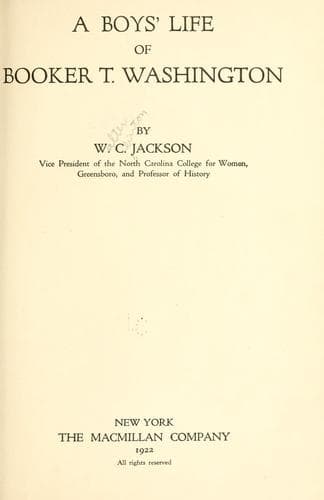
A boys' life of Booker T. WashingtonJackson, Walter Clinton
History
A boys' life of Booker T. Washington
Jackson, Walter Clinton
African American educators -- Biography -- Juvenile literature; Washington, Booker T., 1856-1915 -- Juvenile literature
Washington was a proud and independent man. Many people thought he was
conceited. He was far too great a man for that. He was not vain and he
was not ashamed of himself or his race. He held his head high. He could
not be cowed. He had great self-confidence. He knew his abilities and
powers and thought it his duty to appraise them properly. This he did in
a very intelligent and sensible way. But he was not boastful; in fact,
he was very humble. Many of the things which he said and did that were
often taken for personal vanity and boastfulness were not personal at
all but were evidences of his pride in his race.
Washington had great sympathy for the unfortunate. He was constantly
bringing up in faculty meeting the case of some poor negro who was in
distress,—who couldn’t pay the rent, was without food or clothes, or was
in hard luck in some way. He insisted that these people be helped
regardless of how they came to be in their unfortunate condition.
Scarcely a day passed that he did not give aid to some one who needed
it.
There was an old, crack-brained preacher who would come to the Institute
and speak by the hour right outside the office, but Washington would not
let him be disturbed and always gave him a little contribution.
There was another old negro who had great ability in getting
contributions from Washington. “One day, when Washington was driving
down the main street of Tuskegee behind a pair of fast and spirited
horses, this old man rushed out into the street and stopped him as
though he had a matter of the greatest urgency to impart to him. When
Mr. Washington had with difficulty reined his horses and asked him what
he wanted, the old man said breathlessly, ‘I’se got a tirkey for yo’
Thanksgivin’!’
“‘How much does it weigh?’ inquired Mr. Washington.
“‘Twelve to fifteen poun’.’
“After thanking the old man warmly, Mr. Washington started to drive on,
when the old fellow added, ‘I jest wants to borrow a dollar for to
fatten yo’ tirkey for you!’
“With a laugh, Mr. Washington handed the old man a dollar, and drove on.
He never could be made to feel that by these spontaneous generosities he
was encouraging thriftlessness and mendicancy. He was incorrigible in
his unscientific open-handedness with the poor, begging older members of
his race.”[38]
Public-domain text, read in full here on John Shaqi.
Reviews
Reviews
No reviews yet
Be the first to share your thoughts on this work.
Elsewhere in the archive
Join the Discussion
Join the discussion
Sign in to leave a comment or review.
Sign InorCreate an account