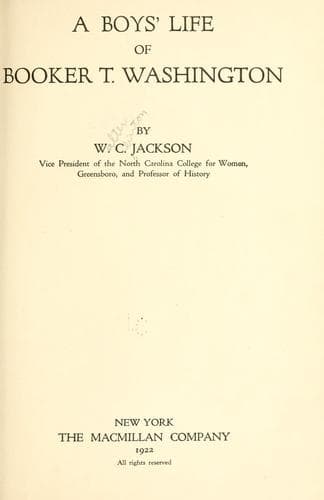
A boys' life of Booker T. WashingtonJackson, Walter Clinton
History
A boys' life of Booker T. Washington
Jackson, Walter Clinton
African American educators -- Biography -- Juvenile literature; Washington, Booker T., 1856-1915 -- Juvenile literature
“Old man Harry Varner was the night watchman of the school in its early
days, and a man upon whom Mr. Washington very much depended. He lived in
a cabin opposite the school grounds. After hearing many talks about the
importance of living in a real house instead of a one- or two-room
cabin, old Uncle Harry finally decided that he must have a real house.
Accordingly he came to his employer, told him his feeling in the matter,
and laid before him his meagre savings, which he had determined to spend
for a real house. Mr. Washington went with him to select the lot and
added enough out of his own pocket to the scant savings to enable the
old man to buy a cow and a pig and a garden plot as well as the house.
From then on, for weeks, he and old Uncle Harry would have long and
mysterious conferences over the planning of that little four-room
cottage. It is doubtful if Mr. Washington ever devoted more time or
thought to planning any of the great buildings of the Institute. No
potentate was ever half as proud of his palace as Uncle Harry of his
four-room cottage, when it was finally finished and painted and stood
forth in all its glory to be admired of all men. And Booker Washington
was scarcely less proud than Uncle Harry.
“With Uncle Harry Varner, ‘Old man’ Brannum, the original cook of the
school, and Lewis Adams, of the town of Tuskegee, whom Mr. Washington
mentions in ‘Up from Slavery,’ as one of his chief advisers, all
unlettered-before-the-war negroes, his relationship was always
particularly intimate. These three old men enjoyed the confidence of the
white people of the town of Tuskegee to an unusual extent and often
acted as ambassadors of good will between the head of the school and his
white neighbors, when from time to time the latter showed a disposition
to look askance at the rapidly growing institution on the hill beyond
the town.
“Another intimate friend of Mr. Washington’s was Charles L. Diggs, known
affectionately on the school grounds as ‘Old man’ Diggs. The old man had
been body servant to a Union officer in the Civil War, and after the war
had been carried to Boston, where he became the butler in a fashionable
Back Bay family. When Mr. Washington first visited Boston, as an humble
and obscure young negro school-teacher, pleading for his struggling
school, he met Diggs, and Diggs succeeded in interesting his employers
in the sincere and earnest young teacher. When, years afterward, the
Institute had grown to the dignity of needing stewards, Mr. Washington
employed his old friend as steward of the Teachers’ Home. In all the
years thereafter hardly a day passed when Mr. Washington was at the
school without having some kind of powwow with ‘Old man’ Diggs regarding
some matter affecting the interests of the school.
Public-domain text, read in full here on John Shaqi.
Reviews
Reviews
No reviews yet
Be the first to share your thoughts on this work.
Elsewhere in the archive
Join the Discussion
Join the discussion
Sign in to leave a comment or review.
Sign InorCreate an account