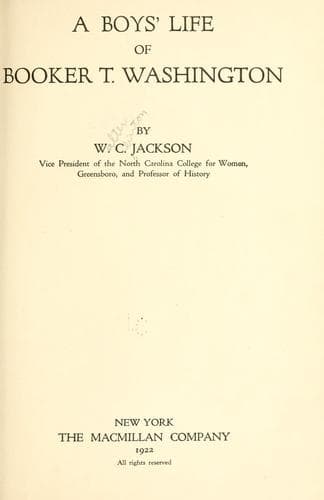
A boys' life of Booker T. WashingtonJackson, Walter Clinton
History
A boys' life of Booker T. Washington
Jackson, Walter Clinton
African American educators -- Biography -- Juvenile literature; Washington, Booker T., 1856-1915 -- Juvenile literature
He had a strong sense of justice. He believed the problems of the white
race as well as those of the black race must be settled on a basis of
justice, if they were ever to be settled right. The fact that he
constantly spoke of justice and fair dealing toward the white race
showed that there was no color boundary to this great attribute of his
character. He was not quarrelsome; he did not hate; he did not lose his
temper when he saw injustice being done to his people. However, he never
did condone such injustice; he was ever ready to denounce it. He labored
unceasingly to bring about a mutual understanding between the two races
and to inspire in his own race those principles which he saw with such
clear vision. He said that the negro ought to put more time on improving
his opportunities than crying over his disadvantages. He believed that
the first and most important thing was for the negro to become well
prepared for the ballot, and by and by he would get it. He argued that
the negroes should work and save and study and conduct themselves in the
proper way, and that in course of time recognition would come to them.
Sooner or later, the right, the just thing, would prevail, and the
important thing for the negro was to know he was right.
[Illustration:
BOOKER T. WASHINGTON AND HIS GRANDCHILDREN
]
Washington had the courage to denounce those members of his own race,
particularly some of the ministers, who did not live as they should.
This was a bold thing to do and brought much criticism upon him, but, in
the long run, it was a great service to his race and to the whole
country.
In spite of the fact that Washington was a man of unusual health and
strength, his hard work and the great responsibilities he carried began
finally to tell on him. But he kept on. He had wonderful will power, and
he would drive himself to his work from day to day, when other men would
have taken to their beds. He could not admit to himself that he was
losing strength. Right up to the last, he did an enormous amount of
work.
In the early fall of 1915, he went North to deliver an address before
the National Council of Congregational Churches, held in New Haven,
Connecticut. Although he had not been entirely well for some time, no
one had any idea that he was seriously ill. Shortly after the address in
New Haven, he collapsed. His friends in New York City had him removed to
St. Luke’s Hospital there.
The physicians made a careful examination and frankly told him that he
was critically ill and could live but a few hours. When he learned that
he must die, he insisted on starting for home at once. The doctors told
him that he could not go; that it would mean certain death; that he
could not live through the journey. His reply was: “I was born in the
South, I have lived and labored in the South, and I expect to die and be
buried in the South.”
Public-domain text, read in full here on John Shaqi.
Reviews
Reviews
No reviews yet
Be the first to share your thoughts on this work.
Elsewhere in the archive
Join the Discussion
Join the discussion
Sign in to leave a comment or review.
Sign InorCreate an account