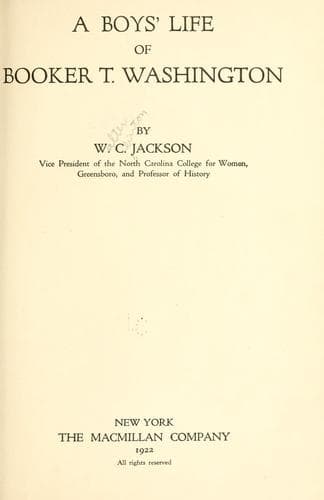
A boys' life of Booker T. WashingtonJackson, Walter Clinton
History
A boys' life of Booker T. Washington
Jackson, Walter Clinton
African American educators -- Biography -- Juvenile literature; Washington, Booker T., 1856-1915 -- Juvenile literature
Arrangements were hurriedly made for the journey to Tuskegee. No one
believed that he would reach there alive. One of the doctors had said
that it was “uncanny to see a man up and about who ought, by all the
laws of nature, to be dead.” When they reached the railway station in
New York a rolling chair had been provided for Washington, but he
refused to use it and walked to the train leaning on the arms of his
friends.
As the train pulled out and headed for his beloved Southland, his
spirits began to revive, and he seemed much stronger. He was determined
to beat death in this race. As they journeyed on, he would ask the names
of the stations. When he was told that they were passing Greensboro, a
triumphant look came into his eyes. Charlotte, Greenville, Atlanta—he
was winning! Finally they came to Chehaw, the little station five miles
from Tuskegee, the junction point of the railroad from Tuskegee to the
main line.
A few more minutes, and he saw the familiar and much loved scenes of his
own Tuskegee.
He had won!
But his victory was a short one. For when the sun came up on the next
morning, the fourteenth day of November, 1915, Booker Washington was
dead.
INDEX
Alabama Hall, 69–70.
Alabama Legislature, 45, 75.
Armstrong, Gen. S. C., accompanies Washington on tour, 70;
founder of Hampton, 23–24;
invites Washington as commencement speaker, 32, 77;
sends Washington to Tuskegee, 45;
sketch of, 22.
_Atlanta Constitution_, 81.
Atlanta Speech, 79–81.
Baldwin, William H. Jr., President of Board of Trustees, Tuskegee
Institute, 73, 138.
Belgium, Washington’s visit to, 122.
Books, written by Washington, 108.
Buildings, first at Tuskegee, 50–51, 58.
Bulloch, Gov., of Ga., 81.
Business League, National Negro, 109.
Cabbages, an oration on, 96.
Cabin, description of a, 3.
Capital, campaign for removal, W. Va., 37.
Carnegie, Andrew, 71, 73, 111.
Carney, Sergeant William H., 85.
Chicago Peace Convention, 106.
“Chopping bee,” 52.
Coal mine, 12–13.
Coat, sale of, 28.
Commencement exercises at Tuskegee, 93–95.
Copenhagen, Washington’s visit to, 127.
Corner stone, first building at Tuskegee, 59–60.
Cotton States Exposition, 78.
Creelman, James, 79.
Davidson, Olivia, 49, 66.
Denmark, Washington’s visit to, 127.
Douglass, Frederick, 76, 82, 105.
Education of negro, effect of, 90–91;
future of, 104;
negro education after Civil War, 22;
Washington’s idea of, 91–93, 98, 103.
Eliot, President C. W., 67.
“Emancipation Proclamation,” 8.
“Entitles,” 9.
Europe, Washington’s trips to, 119–128.
Extension work of Tuskegee, 100.
Farm, purchase of, 50–51.
“Festivals,” 54.
Freedmen’s Bureau, 90.
Gifts to Tuskegee, 54, 74–75.
Hales’ Ford, Washington’s birthplace, 3.
Hampton Institute, 15, 17, 20, 22–23, 26–27, 29–30, 32, 34.
Harvard University, 82.
Holland, Washington’s visit to, 122.
Public-domain text, read in full here on John Shaqi.
Reviews
Reviews
No reviews yet
Be the first to share your thoughts on this work.
Elsewhere in the archive
Join the Discussion
Join the discussion
Sign in to leave a comment or review.
Sign InorCreate an account