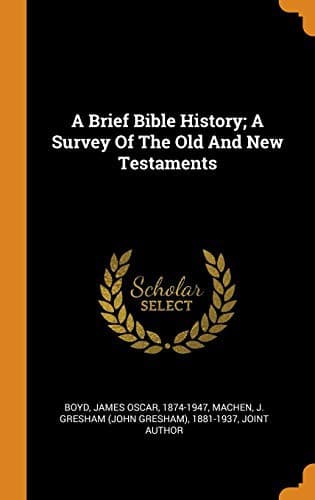
A Brief Bible History: A Survey of the Old and New TestamentsMachen, J. Gresham (John Gresham)
Religion
A Brief Bible History: A Survey of the Old and New Testaments
Machen, J. Gresham (John Gresham)
Bible stories, English
It has often been said that while civilization owes its art and
letters to Greece and its law and order to Rome, it owes its
religion and ethics to Palestine. This is true, within limits,
provided we understand that what Israel contributed was not the
product of its "native genius for religion," but was due to the
persistent grace of its God, who took this "fewest of all peoples"
and made of it the custodian of his revelation and the cradle of his
redemption for the whole world. When, however, the Hebrew claimed
preëminence through these two things, a saving God and a righteous
Law, it was no idle boast. So Moses eloquently asks in Deuteronomy:
"What great nation is there, that hath a god so nigh unto them,
as Jehovah our God is whensoever we call upon him? And what great
nation is there, that hath statutes and ordinances so righteous as
all this law, which I set before you this day?" Deut. 4:7, 8.
Religion as developed in Israel had two sides, an inward and an
outward. On its inward side it consisted of a faith in Jehovah
cherished in the hearts of the people, together with the sentiments
of reverence and love, and the purposes of loyalty and consecration,
which grew out of that faith. On its outward side religion consisted
of certain objects and ceremonies, adapted to express by act and
symbol the relation between God and his people.
But there is also another distinction often made in speaking of
religion, the distinction between individual religion and national
religion. Each member of the Hebrew nation held a personal relation
to his God. The Law of God addressed him individually as it said
to him, "Thou shalt not." And, on a still higher level, Moses
summed up that Law for him in these memorable words, "Thou shalt
love the Lord thy God with all thy heart." Yet the entire body of
Israel, as such, held a relation to God which his spokesmen are
continually trying to illustrate and enrich by all sorts of figures.
God is Israel's "Rock," "Possessor" or "Purchaser," "Redeemer,"
"Father"--until Isaiah can even say to the nation, "Thy Maker is
thy husband," and Hosea and Ezekiel can portray God's dealings with
Israel under the allegory of a marriage.
Public-domain text, read in full here on John Shaqi.
Reviews
Reviews
No reviews yet
Be the first to share your thoughts on this work.
Join the Discussion
Join the discussion
Sign in to leave a comment or review.
Sign InorCreate an account