A Candid Examination of TheismRomanes, George John
Religion
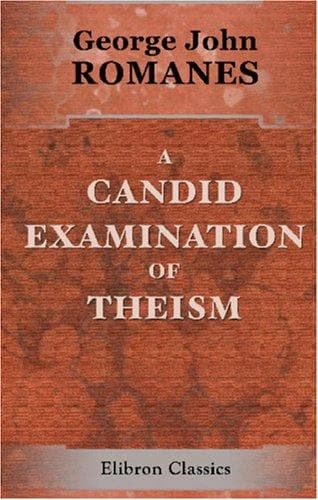
A Candid Examination of Theism
Romanes, George John
Theism
In the first place, it is needful to protest against an argument which our
author adopts on the authority of Professor Clark Maxwell. The argument is
now a well-known one, and is thus stated by Professor Maxwell in his
presidential address before the British Association for the Advancement of
Science, 1870:--"None of the processes of nature, since the time when
nature began, have produced the slightest difference in the properties of
any molecule. We are therefore unable to ascribe either the existence of
the molecules or the identity of their properties to the operation of any
of the causes which we call natural. On the other hand, the exact quality
of each molecule to all others of the same kind gives it, as Sir John
Herschel has well said, the essential character of a manufactured article,
and precludes the idea of its being eternal and self-existent. Thus we have
been led along a strictly scientific path, very near to the point at which
science must stop. Not that science is debarred from studying the external
mechanism of a molecule which she cannot take to pieces, any more than from
investigating an organism which she cannot put together. But in tracing
back the history of matter, science is arrested when she assures herself,
on the one hand, that the molecule has been made, and, on the other, that
it has not been made by any of the processes we call natural."
Now it is obvious that we have here no real argument, since it is obvious
that science can never be in a position to assert that atoms, the very
existence of which is hypothetical, were never "made by any of the
processes we call natural." The mere fact that in the universe, as we now
know it, the evolution of material atoms is not observed to be taking place
"by any of the processes we call natural," cannot possibly be taken as
proof, or even as presumption, that there ever was a time when the material
atoms now in existence were created by a supernatural cause. The fact
cannot be taken to justify any such inference for the following reasons. In
the first place, assuming the atomic theory to be true, and there is
nothing in the argument to show that the now-existing atoms are not
self-existing atoms, endowed with their peculiar and severally distinctive
properties from all eternity. Doubtless the argument is, that as there
appear to be some sixty or more elementary atoms constituting the raw
material of the observable universe, it is incredible that they can all
have owed their correlated properties to any cause other than that of a
designing and manufacturing intelligence. But, in the next place--and here
comes the demolishing force of the criticism--science is not in a position
to assert that these sixty or more elementary atoms are in any real sense
of the term elementary. The mere fact that chemistry is as yet in too
undeveloped a condition to pronounce whether or not all the forms of matter
known to her are modifications of some smaller number of elements, or even
Public-domain text, read in full here on John Shaqi.
Reviews
Reviews
No reviews yet
Be the first to share your thoughts on this work.
Elsewhere in the archive
Join the Discussion
Join the discussion
Sign in to leave a comment or review.
Sign InorCreate an account