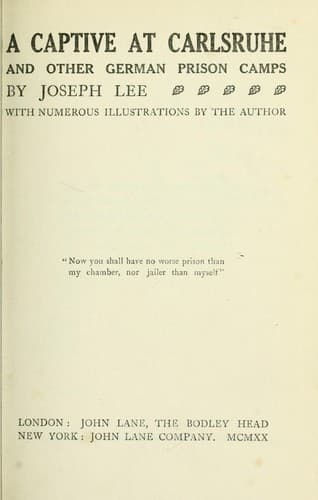
A Captive at Carlsruhe and Other German Prison CampsLee, Joseph
History
A Captive at Carlsruhe and Other German Prison Camps
Lee, Joseph
World War, 1914-1918 -- Personal narratives, British; World War, 1914-1918 -- Prisoners and prisons, German
Captain Teixeira could not only imitate the song of birds. He was a
singer himself. Among many other manifestations of friendship, he
gave me a set of improvisations, “Songs from Coimbra”--Coimbra, a
University town and capital of the Portuguese province of Beira, giving
its name to that school of poetry which had inception in 1848 with
the publication of “O Trovador.” I have made effort to convert these
“Cantares” into English verse:
I
Let my coffin be
Of shape strange and bizarre--
The shape of a heart,
The shape of a guitar!
II
If a man should be slain,
And a cross mark his rest,
He shall also have grave,
Little brown girl, in your breast!
III
There are caverns in my breast
As in the bottoms of the sea
Fashioned by tides of tears,
And sorrows surging in me.
IV
Some day when I die
O love, warm and rare,
In a shroud let me lie
Of your shadowy hair.
A GERMAN BOMBARDMENT
One afternoon German aviators bombarded the camp--very harmlessly,
however--with broadsheets, and not with bombs. After an exciting race
and scrum I succeeded in securing a copy. It was in the form of a
child’s catechism, with as heading a quaint woodcut of a town on the
Rhine. It commenced: “Mother: My child, lovst thou thy Fatherland?
Son: Yes, mother, Yes, with my whole heart. Mother: Why lovst thou thy
Fatherland? Son: Because there was I cradled.” It ended with an appeal
for the Eighth War Loan.
Although we had, of course, no access to English newspapers, the German
authorities permitted us to order the _Frankfurter Zeitung_ and the
_Berliner Tageblatt_, and from these the most imperative news was
translated and written up daily in a _communiqué_ book. During more
urgent periods _Extrablätter_ were posted up in the dining hut. Thus
news of the great German offensive in March, 1918 percolating into
camp caused us unutterable dullness and depression. Most of us seemed
absolutely helpless and hopeless in these dark days.
“I love my country,” said Lieut. H---- chokingly.
To make matters worse there was almost an entire clearance of the camp,
including many of the men who had added to the gaiety of such nations
as were here represented. Flags were flying, and in the distant streets
one could hear the sound of singing and cheering. Whether by chance,
however, or, as is possible, by more delicate design, none of the
banners, except the two official ones at the gate, were hung so high
in the surrounding houses as blatantly and jubilantly to overlook the
camp. In the case of the Russian peace, as in that with the Ukraine,
the flags were hung from the topmost stories; in the present instance
they were not hung above the level of the palisades, and were more
evidently intended for the man in the street.
THE BATH ATTENDANT
Public-domain text, read in full here on John Shaqi.
Reviews
Reviews
No reviews yet
Be the first to share your thoughts on this work.
Join the Discussion
Join the discussion
Sign in to leave a comment or review.
Sign InorCreate an account