Produced by Chris Curnow, David E. Brown and the Online
Distributed Proofreading Team at https://www.pgdp.net (This
file was produced from images generously made available
by The Internet Archive)
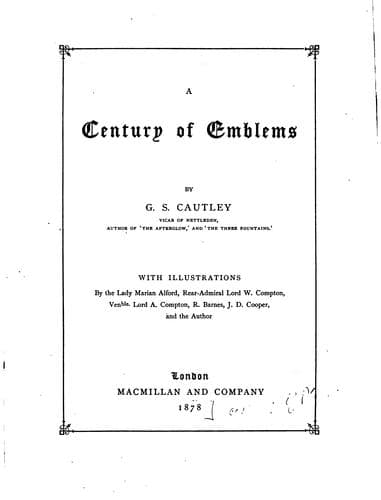
A CENTURY OF EMBLEMS
_Printed by R. & R. CLARK, Edinburgh._
A
Century of Emblems
BY
G. S. CAUTLEY
VICAR OF NETTLEDEN,
AUTHOR OF 'THE AFTERGLOW,' AND 'THE THREE FOUNTAINS.'
WITH ILLUSTRATIONS
By the Lady Marian Alford, Rear-Admiral Lord W. Compton,
Ven^{ble.} Lord A. Compton, R. Barnes, J. D. Cooper,
and the Author
London
MACMILLAN AND COMPANY
1878
[Illustration]
[Illustration: A
CENTURY
OF
EMBLEMS]
To the Memory
OF
CHARLES DOUGLAS,
MARQUIS OF NORTHAMPTON,
THIS LITTLE BOOK,
MAINLY DUE IN ITS PRESENT FORM TO
HIS GENEROSITY AND COUNSEL,
IS DEDICATED,
IN ALL GRATEFUL AND TENDER RECOLLECTION
BY
THE AUTHOR.
[Illustration]
PREFACE.
This small volume is the latest of above three thousand[1] of a similar
kind, which, under the general title of "Books of Emblems" have followed
in the wake of the _Libellus Emblematum_,[2] a work, much resembling a
child's primer in outward appearance, published at Augsburg in A.D.
1532, and composed by Andrea Alciati, a famous lawyer, antiquary, and
litterateur of Milan.
This book consisted of nearly a hundred Latin Epigrams, some original,
some translated or paraphrased from the Greek, and each accompanied by
a rude woodcut illustration. Alciati was the first author who gave the
name of Emblem to this form of expressing his ideas: and the notion for
so doing was suggested by the original meaning of the word Emblem, which
signifies anything inserted. The Greeks and Romans used to insert small
pictures or bas-reliefs in the sides of vases, drinking-cups, and
various other utensils: these little works of art were called Emblems:
they were sometimes accompanied by mottoes or verses, and often made
removable at pleasure, so that they formed no necessary part of the
article which they adorned.
Alciati, therefore, considering that the illustrations formed no
necessary portion of his book, and that they were only inserted, as he
says himself, to make his moral and philosophical teaching more
attractive, gave to his collection of poems and pictures the name of
"Book of Emblems."
This idea took greatly with the public of his day, and for upwards of
two hundred years afterwards, and generated a class of books now
reckoned among the fossils of literature, which may be dug out of
ancient libraries, or procured by chance here and there through the
agency of those useful purveyors, the publishers of Catalogues of
second-hand works.
Public-domain text, read in full here on John Shaqi.
Reviews
Reviews
No reviews yet
Be the first to share your thoughts on this work.
Join the Discussion
Join the discussion
Sign in to leave a comment or review.
Sign InorCreate an account