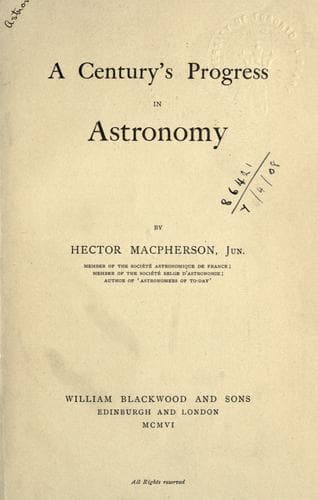
A Century's Progress in AstronomyMacpherson, Hector
History
A Century's Progress in Astronomy
Macpherson, Hector
Astronomy -- History
Campbell finds that of 285 stars observed by him, more than one in nine
is a spectroscopic binary. He concludes that at least one star in five
or six will be found to be spectroscopically double, and considers that
“the proven existence of so large a number of stellar systems, differing
so widely in structure from the Solar System, gives rise to a suspicion
at least that our system is not of the prevailing type of stellar
systems.”
The study of triple and multiple stars is of deep interest, but the
orbits of these objects cannot be said to be fully investigated by any
means. The first application of the problem of three bodies to stellar
astronomy was made by Seeliger in 1889. His researches, relating to the
famous star, ζ Cancri, disclosed the existence of three stars revolving
round a dark body, apparently the most massive in the system. The system
of ζ Cancri, at least, seems to be modelled on the Ptolemaic design.
In the study of star-clusters and nebulæ, as in the investigation of
double stars, Herschel’s successor was his son. His observations, both
in England and at the Cape of Good Hope, resulted in a large number of
new discoveries, and the results of his studies in this direction were
published in 1864 in his catalogue of all known clusters and nebulæ,
amounting to 5079. This catalogue was enlarged and revised in 1888 by
_John Louis Emil Dreyer_ (born 1852), a Danish astronomer, but director
of the Observatory at Armagh, in Ireland; and the same observer
published from 1888 to 1894 a supplementary list, bringing the number of
known clusters and nebulæ to about 10,000.
In the early part of his career, John Herschel held firmly to the views
of his father of the difference between star-clusters and nebulæ,
considering the latter to be composed of “shining fluid.” But he fell
off from this view with the resolution into stars of many irresolvable
nebulæ. In 1845 _William Parsons_, third _Earl of Rosse_ (1800-1867),
erected at Birr Castle, in Ireland, his great 6-foot reflector, which
still surpasses all other telescopes in point of size. With this
instrument Lord Rosse believed himself to have resolved the Crab nebula
in Taurus and the Nebula in Orion, which was also said to have been
resolved by Bond with the 15-inch refractor at Harvard; and in 1854
Olmsted declared the “resolution” of these nebulæ to be the signal for
the renunciation of Herschel’s nebular theory. Most astronomers fell in
with the view that all the nebulæ were distant clusters, which would
eventually be resolved into stars, although it is only right to state
that the Scottish astronomer, _John Pringle Nichol_ (1804-1859), and
some other investigators, held to the theory of Herschel.
Public-domain text, read in full here on John Shaqi.
Reviews
Reviews
No reviews yet
Be the first to share your thoughts on this work.
Elsewhere in the archive
Join the Discussion
Join the discussion
Sign in to leave a comment or review.
Sign InorCreate an account