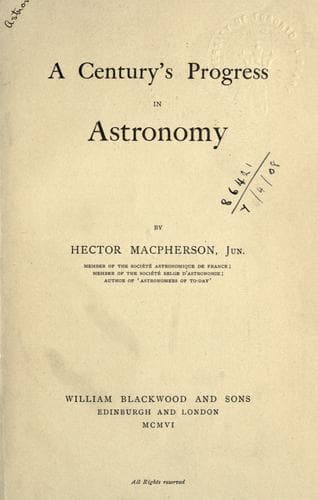
A Century's Progress in AstronomyMacpherson, Hector
History
A Century's Progress in Astronomy
Macpherson, Hector
Astronomy -- History
The solution of the great problem was in 1864, when on August 29 of that
year Huggins turned his spectroscope on a bright planetary nebula in
Draco. To his amazement the spectrum was one of bright lines, proving
conclusively that the nebula was not a star-cluster, but a mass of
glowing gas,—hydrogen, and some other unknown substance, now named
“nebulium.” By 1868 Huggins had observed the spectra of seventy nebulæ.
Of these one-third proved to be gaseous, among them the great Orion
nebula which Lord Rosse was believed to have resolved into stars. In the
spectrum of the latter, the “chief nebular line” was at first ascribed
by Huggins to nitrogen, but this was a mistake. Later, it was believed
by Lockyer to coincide with the fluting of magnesium, but this was
disproved by Huggins in 1889-90, and by Keeler in 1890-91. The great
nebula in Andromeda and the great spiral in Canes Venatici were found by
Huggins to display a continuous spectrum, and a similar discovery was
made in regard to the cluster M 13 in Hercules, and other star-clusters.
In the case of the nebulæ, it is not believed that the continuous
spectrum is due to the existence of sun-like bodies, as a gas under
pressure would give a continuous spectrum.
The Orion nebula has been more thoroughly studied than any other object
of its class. The application of photography to spectroscopy has done
much to further the study of the lines in the nebular spectrum. In 1886
Copeland detected in the spectrum of the Orion nebula the yellow ray of
helium. On February 13, 1890, Scheiner announced an important discovery,
namely, the possession by both the nebula and the stars in Orion—with
the exception of Betelgeux—of a line, which appeared bright in the
nebular spectra and dark in the stellar. This line was identified by
Vogel, Lockyer, and others with that of helium.
Nebular photography was inaugurated in 1880 by Draper, who obtained a
remarkably good representation of the Orion nebula in that year. His
work in this direction, cut short by his death in 1882, was taken up by
Janssen at Meudon, and by Common in England, who obtained, in 1883,
several excellent photographs. Later photographs have shown the Orion
nebula to be much more extended than visual observations would lead one
to expect. A photograph secured in 1890 by W. H. Pickering revealed the
nebulous matter in Orion in its true form, that of a gigantic spiral,
starting from near Bellatrix, sweeping past κ Orionis and Rigel to η,
and joining with the great nebula surrounding θ; the entire
constellation being thus shown to be enwrapped in nebulous haze.
Public-domain text, read in full here on John Shaqi.
Reviews
Reviews
No reviews yet
Be the first to share your thoughts on this work.
Elsewhere in the archive
Join the Discussion
Join the discussion
Sign in to leave a comment or review.
Sign InorCreate an account