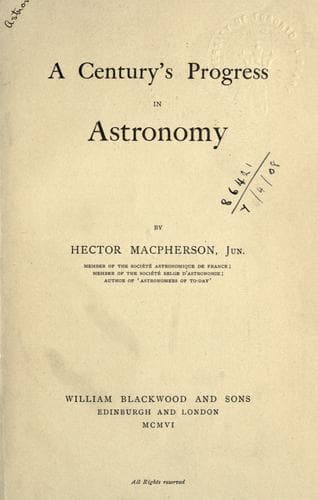
A Century's Progress in AstronomyMacpherson, Hector
History
A Century's Progress in Astronomy
Macpherson, Hector
Astronomy -- History
An idea of the vast importance of Keeler’s work may be
gained if we reflect that the observations of all the earlier
astronomers resulted in the discovery of six thousand nebulæ. The
investigations of Keeler, in all probability, were the means of adding
120,000 more.
Many observations have been made on nebulæ, for the purpose of
ascertaining their proper motions—but without success. Measurements were
made by D’Arrest in 1857 and by Burnham in 1891, but none of these
revealed any motion of the nebulæ across the line of sight. Even the new
spectroscopic method of determining motions in the line of sight, in the
hands of Huggins, failed in the case of the nebulæ. With the great Lick
refractor at his disposal, Keeler attacked the subject in 1890, and
measured the radial velocities of ten nebulæ. He found that the
well-known planetary nebula in Draco was moving towards the Solar System
at the rate of 40 miles a second; for the Orion nebula he found a motion
of recession of 11 miles a second; but probably this belongs chiefly to
the movement of the Solar System in the opposite direction.
Unfortunately Keeler did not live to carry on his investigations in
nebular astronomy. His early death brought to an abrupt end these
fruitful investigations. Appointed director of the Lick Observatory in
1898, he died suddenly at San Francisco on August 12, 1900, at the early
age of forty-two.
CHAPTER XII.
STELLAR DISTRIBUTION AND THE STRUCTURE OF THE UNIVERSE.
After the death of Herschel there was little done in the direction of
furthering our knowledge of stellar distribution, or the construction of
the heavens. Here, as elsewhere, Herschel’s immediate successor was his
son, whose star-gauges, both in England and in South Africa, were a
worthy sequel to those of his father; but John Herschel, in his books on
astronomy, reproduced his father’s disc-theory, unaware that the elder
Herschel had himself abandoned it. The work of the younger Herschel was
entirely supplementary to that of his father.
Public-domain text, read in full here on John Shaqi.
Reviews
Reviews
No reviews yet
Be the first to share your thoughts on this work.
Elsewhere in the archive
Join the Discussion
Join the discussion
Sign in to leave a comment or review.
Sign InorCreate an account