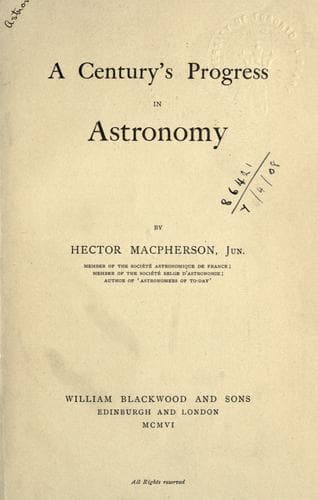
A Century's Progress in AstronomyMacpherson, Hector
History
A Century's Progress in Astronomy
Macpherson, Hector
Astronomy -- History
To Wilhelm Struve belongs the credit of showing the disc-theory to be
untenable, and of demonstrating that Herschel had abandoned it. This he
was able to do after a perusal of Herschel’s papers, presented to him by
John Herschel. Having demonstrated this, he undertook a series of
investigations which resulted in his famous theory of the Universe. This
was published in his work ‘Études d’Astronomie Stellaire,’ which was
published in 1847. His researches were based on the star-catalogues of
Bessel, Piazzi, and others; and dealing with 52,199 stars, he discussed
the number of stars in each zone of Right Ascension. He found, in the
words of Mr Gore, “that the numbers increase from hour i to hour vi,
where they attain a maximum. They then diminish to a minimum at hour
xiii, and rise to another but smaller maximum at hour xviii, again
decreasing to a second minimum at hour xxii. As the hours vi and xviii
are those crossed by the Milky Way, the result is very significant.” He
concluded the Galaxy to be produced by a collection of
irregularly-condensed clusters, the stars condensed in parallel planes.
Next, he considered the Universe as perhaps infinitely extended in the
direction of the Galaxy, and accordingly he put forward the idea that
the light from the fainter and more distant stars was extinguished in
its passage through the ether of space, which he regarded as imperfectly
transparent. The theory, as Struve propounded it, was disposed of by Sir
John Herschel, who remarked that we were not permitted to believe that
at one part of the sky our view was limited by extinction, while at
another a clear view right through the Galaxy could be had; and by
_Robert Grant_ (1814-1892), director of the Glasgow Observatory, who
showed that, were the theory true, the Galaxy should present a uniform
appearance throughout its course. On the whole, Struve’s theory was no
improvement on Herschel’s; for, as Encke pointed out, Struve’s theory
was built on five assumptions, all of which were questionable.
Public-domain text, read in full here on John Shaqi.
Reviews
Reviews
No reviews yet
Be the first to share your thoughts on this work.
Elsewhere in the archive
Join the Discussion
Join the discussion
Sign in to leave a comment or review.
Sign InorCreate an account