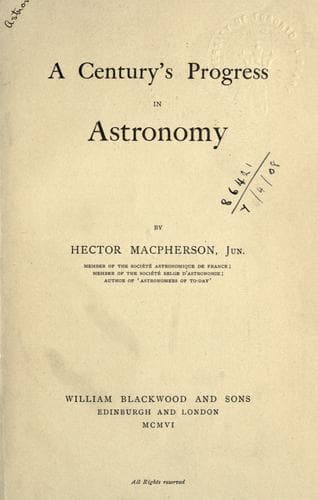
A Century's Progress in AstronomyMacpherson, Hector
History
A Century's Progress in Astronomy
Macpherson, Hector
Astronomy -- History
Perhaps the most elaborate investigations on the structure of the
Universe have been those of Kapteyn, commenced in 1891. In that year he
demonstrated that stars are bluer and more easily photographed in the
Galaxy than elsewhere, a discovery independently made by Gill at the
Cape, and Pickering at Harvard. In 1893 Kapteyn announced his
conclusions, derived from a novel method of studying the distance of the
stars from their proper motions. In order to reach a definite idea of
the distances of the stars, he made use of the component of the proper
motion, measured at right angles to a great circle of the sphere which
passes through a given star and the apex of the solar motion. He found
that stars of the first spectral type have smaller proper motions than
those of the second, indicating that stars of the second type are on the
average nearer to the Solar System than those of the first, the near
vicinity containing almost exclusively second-type stars. Kapteyn
concluded that the group of second-type stars formed one system, named
the solar cluster, which he considered to be roughly spherical in shape.
In 1902 he abandoned this idea, retaining, however, his opinions as to
the relative distances of the different types. That the second-type
stars are nearer to the Sun than the first is, he remarked in a letter
to the writer, incontrovertible.
In the investigation of the motions in, and extent of, the Universe, the
name of Simon Newcomb stands out pre-eminently. Born in 1835 at Wallace,
in Nova Scotia, he went to the States in 1853. In 1862 he received an
appointment at Washington Observatory, and he retained an official
position until 1897. Throughout his scientific career he has been
specially attracted by the question of the construction of the heavens,
which he fully discussed in his book on ‘The Stars’ in 1901. Newcomb’s
investigations have shown that some of the stars are not permanent
members of the Sidereal System, among them the swiftly-moving 1830
Groombridge. He has shown that the Stellar Universe does not possess
that form of stability which is seen in the Solar System. Newcomb
considers the Universe to be limited in extent, as opposed to the
opinions of Struve and others, who believed it to be infinite. He has
brought clearly before his readers a calculation, based on the known law
that there are three times as many stars of any given magnitude as of
that immediately brighter, the increase of number compensating for the
decrease of brilliance. Were the Universe infinitely extended, the whole
heavens would shine with the brilliance of the Sun. Newcomb, therefore,
concludes that “that collection of stars which we call the Universe is
limited in extent.”
Public-domain text, read in full here on John Shaqi.
Reviews
Reviews
No reviews yet
Be the first to share your thoughts on this work.
Elsewhere in the archive
Join the Discussion
Join the discussion
Sign in to leave a comment or review.
Sign InorCreate an account