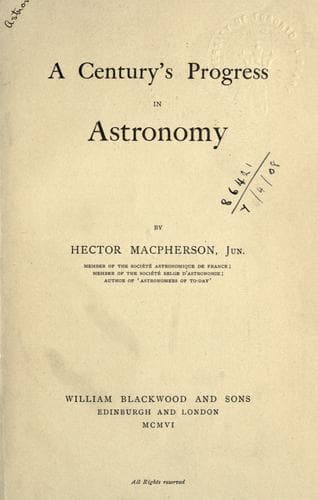
A Century's Progress in AstronomyMacpherson, Hector
History
A Century's Progress in Astronomy
Macpherson, Hector
Astronomy -- History
Positive evidence that this is the case was obtained by Giovanni
Celoria, now director of the Milan Observatory, in the course of a
series of star-gauges at the north galactic pole. Using a small
refractor, showing stars barely to the eleventh magnitude, he found he
could see exactly the same number of stars as Herschel’s large
reflector, indicating that increase of optical power will not increase
the number of stars visible in that direction. Celoria’s observation can
only be explained on the assumption that the Universe is limited in
extent, as otherwise Herschel’s telescope should have shown more stars
than Celoria’s, even granting an extinction of light,—a theory which
Newcomb, Schiaparelli, and others have shown to be quite untenable. That
the Universe is limited in extent is about all that is known for
certain, although even this has been called in question, notably by E.
W. Maunder and H. H. Turner. The problem of the construction of the
heavens is by no means solved, although several more or less probable
theories have been advanced.
A series of investigations on stellar distribution, from 1884 to 1898,
led Hugo Seeliger, director of the Munich Observatory, to some
remarkable deductions. He believes the Universe to be flattened at the
galactic poles. The Galaxy is the zone of stellar condensation, and he
concludes the distance of the Solar System from the inner border of the
zone to be 500 times the distance of Sirius, while the external border
is 1100 times that distance. The Universe is finite in extent, its
limits being about 9000 light years from the Solar System. In Seeliger’s
opinion the extinction of light may come into play beyond our Universe,
and prevent us seeing other collections of stars.
The question of external universes is purely a hypothetical one,
although there is undoubtedly much to be said in its favour. These
universes have never been seen, and we can only speculate as to their
existence. The last word on the subject is by Gore, in 1893, in his
elaborate work, ‘The Visible Universe.’ He regards the Solar System as a
system of the first order, and the Galaxy and its fellow-universes of
the second. He makes a calculation of the possible distance of an
external universe of his second order. He assumes the distance of the
nearest universe from our Galaxy as proportional to that separating the
Sun from α Centauri, and reaches the amazing conclusion that the
distance of the nearest Galaxy is no less than
520,149,600,000,000,000,000 miles,—a distance which light, with its
inconceivable velocity of 186,000 miles a second, would take almost
ninety millions of years to traverse.
Public-domain text, read in full here on John Shaqi.
Reviews
Reviews
No reviews yet
Be the first to share your thoughts on this work.
Elsewhere in the archive
Join the Discussion
Join the discussion
Sign in to leave a comment or review.
Sign InorCreate an account