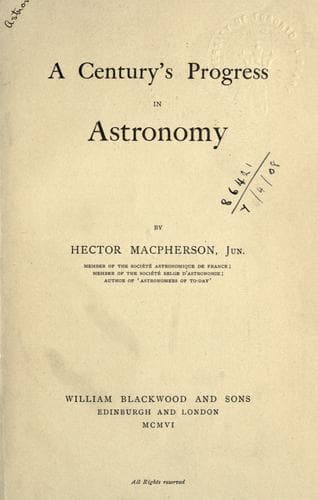
A Century's Progress in AstronomyMacpherson, Hector
History
A Century's Progress in Astronomy
Macpherson, Hector
Astronomy -- History
These calculations absolutely overwhelm the mind, which is unable to
comprehend such vast distances. Our universe is indeed, as Flammarion
expresses it, a point in the infinite. The calculations of J. E. Gore
represent our highest scientific conception of the universe. He sums up
his investigations with the following words: “Although we must consider
the number of _visible_ stars as strictly finite, the numbers of stars
and systems really existing, but invisible to us, may be practically
infinite. Could we speed our flight through space on angel wings beyond
the confines of our limited universe to a distance so great that the
interval which separates us from the remotest fixed star might be
considered as merely a step on our celestial journey, what further
creations might not then be revealed to our wondering vision? Systems of
a higher order might there be unfolded to our view, compared with which
the whole of our visible heavens might appear like a grain of sand on
the ocean shore,—systems perhaps stretching out to infinity before us,
and reaching at last the glorious ‘mansions’ of the Almighty, the Throne
of the Eternal.”
CHAPTER XIII.
CELESTIAL EVOLUTION.
In the second chapter we outlined the nebular hypothesis as propounded
by Herschel. Some time earlier the French mathematician, Laplace, had
put forward his theory of the evolution of the Solar System. _Pierre
Simon Laplace_ was born at Beaumont-en-Auge, near Honfleur, in 1749, and
was educated in the Military School of his native town. In 1767 he
became Assistant Professor of Mathematics at Beaumont, and some years
later at the Military School in Paris, which position he retained for
many years. Member of the Institute and Minister of the Interior under
Napoleon, he was created a Marquis by Louis XVIII., and died at Arcuile
on March 5, 1827.
In the last chapter of his popular work, the ‘Système du Monde,’ Laplace
put forward his nebular theory “with that distrust which everything
ought to inspire that is not the result of observation or calculation.”
Laplace noticed that in the Solar System all the planets revolved round
the Sun in the same direction, from west to east, and that the
satellites of the planets obeyed the same law. He also observed that the
Sun, Moon, and planets rotated on their axes in the same direction as
they revolved round the Sun; also that the planets moved round the Sun,
and the satellites round their primaries, in almost the same plane as
the Earth’s orbit, the plane of the ecliptic. It was evident that these
remarkable congruities were not the result of chance, and accordingly
Laplace expressed his belief that the Solar System originated from a
great nebula, which in condensing detached various rings in the process
of rotation. These rings condensed into the various planets and their
satellites.
Public-domain text, read in full here on John Shaqi.
Reviews
Reviews
No reviews yet
Be the first to share your thoughts on this work.
Elsewhere in the archive
Join the Discussion
Join the discussion
Sign in to leave a comment or review.
Sign InorCreate an account