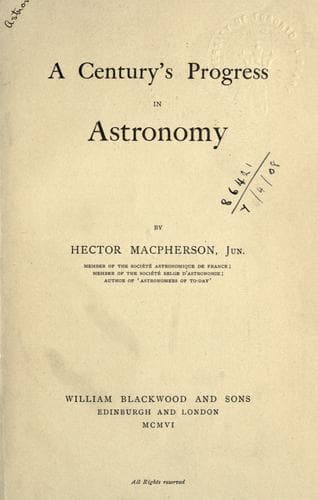
A Century's Progress in AstronomyMacpherson, Hector
History
A Century's Progress in Astronomy
Macpherson, Hector
Astronomy -- History
The theory that the Sun’s heat was maintained by meteors, was extended
by Proctor in 1870 to explain the growth of the planets through meteoric
aggregation as well as nebular condensation. Certainly the theory, as
developed by Proctor, accounted fairly well for the various features of
the Solar System; but the highest development of the meteoritic theory
is due to Lockyer, who published his views in 1890, in his work, ‘The
Meteoritic Hypothesis.’ Lockyer claims that his views are merely
extensions of Schiaparelli’s ideas regarding the concentration of
celestial matter. He considered the chief nebular line to be identical
with the remnant of the magnesium fluting, which is conspicuous in
cometic and meteoric spectra; but Huggins and Keeler, with more powerful
instruments, disproved the supposed coincidence. Lockyer considers that
“all self-luminous bodies in the celestial space are composed either of
swarms of meteorites or of masses of meteoric vapour produced by heat.
The heat is brought about by the condensation of meteor swarms, due to
gravity, the vapour being finally condensed into a solid globe.”
Lockyer divided the stars into seven groups, according to temperature,
the order of evolution being from red stars through a division of
second-type stars to Sirian stars, regarded as the hottest stars;
through a second division of solar stars to fourth-type stars. In fact,
the theory aspires to give a complete explanation of all celestial
phenomena, from meteors to nebulæ. Newcomb, however, considers that the
objections to the theory are insuperable, and his opinion is shared by
the majority of astronomers, many of whom, however, consider that there
are elements of truth in the theory; but Lockyer undoubtedly carried his
ideas to an extravagant extent.
Lockyer’s evolutionary order of the stars is not supported by Vogel.
Zöllner suggested in 1865 that yellow and red stars are simply white
stars in a further stage of cooling; but Angström showed that
atmospheric composition is a safer criterion of age than colour. Vogel’s
classification, first published in 1874, and further developed in 1895,
is from the standpoint of evolution. He considers Orion stars and Sirian
stars to be the youngest orbs. Solar stars are considered by Vogel to
have wasted much of their store of radiation, and red stars are viewed
as “effete suns, hastening rapidly down the road to final extinction.”
He considers stars of Secchi’s fourth type to be also dying suns, both
types representing alternative roads for stars of the Solar type in
their decline into dark stars. This view is supported by Dunér, and is
distinctly confirmed by Hale’s observations with the Yerkes telescope.
Vogel’s views, in fact, are generally accepted among astronomers. The
nebular theory, modified by subsequent research, seems destined to hold
its own against all attacks.
Public-domain text, read in full here on John Shaqi.
Reviews
Reviews
No reviews yet
Be the first to share your thoughts on this work.
Elsewhere in the archive
Join the Discussion
Join the discussion
Sign in to leave a comment or review.
Sign InorCreate an account