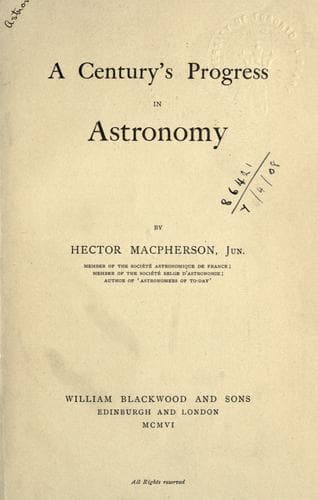
A Century's Progress in AstronomyMacpherson, Hector
History
A Century's Progress in Astronomy
Macpherson, Hector
Astronomy -- History
Distinctly supplementary to the nebular theory are the remarkable
researches, commenced in 1879, by Sir _George Howard Darwin_ (born
1845), son of Charles Darwin the great biologist. George Howard Darwin
was born in 1845, at Downe in Kent, was educated at Cambridge, and
studied for the law; but in 1873 he returned to Cambridge, where he
became Plumian Professor of Astronomy in 1883. In 1879 he communicated
to the Royal Society the first of his papers on tidal friction, which
were summed up in his book on ‘The Tides,’ published in 1898. He finds
that the tides act upon the Earth as a brake does upon a machine,—they
tend to retard its rotation. Consequently, the day is growing longer,
the Moon’s orbit is becoming enlarged, and its period of revolution is
being lengthened.
At present the day is about twenty-four hours long, and the month about
twenty-seven days. The day, however, will be lengthened at a more rapid
rate than the month, and in the remote future the day and month will
both last fifty-five of our present days. The Moon will revolve round
the Earth in the same period that the Earth rotates on its axis, and the
two bodies will perform their circuit round the Sun as if united by a
bar.
Not only can we foresee the future of the Earth-Moon System, but we can
also read the past. According to Darwin’s theory, the Earth, in the
remote past, was probably rotating on its axis in a very short period,
between three and five hours. The Moon must then have been much nearer
us than it is now, and was probably revolving round its primary in the
same period that the Earth took to rotate on its axis. The two globes,
then gaseous, must have been revolving almost in actual contact. Had the
month been even a second shorter than the day, the Moon must inevitably
have fallen back on the Earth. As it was, the condition of affairs could
not endure. The condition of the Moon resembled that of an egg balanced
on its point. The Moon must either recede from the Earth or fall back
upon it. The solar tide here interfered, and caused the Moon to recede
from its primary until it reached its present distance of 239,000 miles.
Public-domain text, read in full here on John Shaqi.
Reviews
Reviews
No reviews yet
Be the first to share your thoughts on this work.
Elsewhere in the archive
Join the Discussion
Join the discussion
Sign in to leave a comment or review.
Sign InorCreate an account