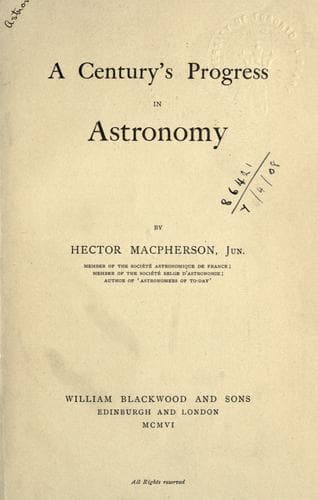
A Century's Progress in AstronomyMacpherson, Hector
History
A Century's Progress in Astronomy
Macpherson, Hector
Astronomy -- History
of the Sun and the condition of the Earth. In 1801 he was inclined to
believe that “some temporary defect of vegetation” resulted from the
absence of sun-spots, which, he thought, “may lead us to expect a
copious emission of heat, and, therefore, mild seasons.” Herschel
believed, in fact, that food became dear at the times of spot-minima. It
may be remarked that Herschel never noted the spot-period of eleven
years, the discovery of which was afterwards made by Schwabe.
Herschel closely scrutinised the surfaces of the planets. Mercury alone
was neglected by him. From 1777 to 1793 he observed Venus, with the
object of determining the rotation period, but he was unable to observe
any markings on the surface of the planet. He did not place reliance on
Schröter’s value of the rotation period (about twenty-three hours).
Meanwhile, Schröter announced the existence on Venus of mountains which
rose to five or six times the height of Chimborazo. As to these, said
Herschel, “I may venture to say that no eye which is not considerably
better than mine, or assisted by much better instruments, will ever get
a sight of them.” Herschel demonstrated the existence of an extensive
atmosphere round Venus.
“The analogy between Mars and the Earth,” Herschel wrote in 1783, “is
perhaps by far the greatest in the whole Solar System.” In 1777 he
began, in his house at Bath, a series of observations on the red planet,
which yielded results of the utmost importance. Fixing his attention on
the white spots at the north and south poles,—discovered by Maraldi,
nephew of Cassini,—he soon ascertained the fact that they waxed and
waned in size, the north polar cap shrinking during the summer of the
northern hemisphere, increasing in winter, and _vice versa_ in the
southern hemisphere. He regarded the caps as masses of snow and ice
deposited from “a considerable, though moderate, atmosphere,” a theory
now generally accepted. Herschel gave an immense impetus to the study of
Mars. He carefully examined the planet’s surface, and the dark markings
were regarded by him as oceans.
During Herschel’s lifetime the four small planets, Ceres, Pallas, Juno,
and Vesta, were discovered by Piazzi, Olbers, and Harding. The great
astronomer was much interested in these small worlds. He commenced a
search through the Zodiacal constellations for new planets, but failed.
He was of opinion that many minor planets would be discovered. Accepting
Olbers’ theory of the disruption of a primitive planet, Herschel
calculated that Mercury might be broken up into 35,000 globes equal to
Pallas. Meanwhile Herschel named the four new planets “Asteroids,” owing
to their minute size. He estimated the diameter of Ceres at 162 miles
and Pallas at 147 miles, but Professor Barnard’s measures have shown
them to be larger.
Public-domain text, read in full here on John Shaqi.
Reviews
Reviews
No reviews yet
Be the first to share your thoughts on this work.
Join the Discussion
Join the discussion
Sign in to leave a comment or review.
Sign InorCreate an account