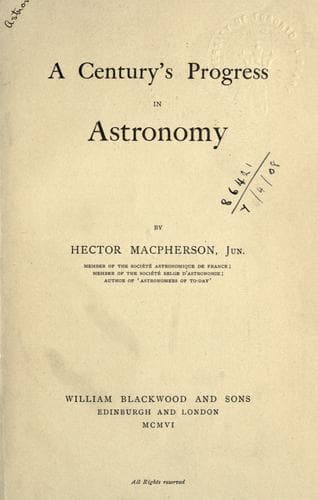
A Century's Progress in AstronomyMacpherson, Hector
History
A Century's Progress in Astronomy
Macpherson, Hector
Astronomy -- History
In his volume ‘Herschel and his Work,’ Mr James Sime writes: “To
Herschel belongs the credit not merely of having suspected the
revolution of sun around sun in the far-distant realms of space, but
also of actually detecting that this was going on among the stars.”
Throughout his career double stars were favourite objects of
observation. The study of double stars was commenced by Herschel while a
musician in Bath. Before his day, of course, double stars had been
discovered and studied, but it was believed that the proximity of two
stars was merely an optical accident, the brighter star being much
nearer to us than the other. Herschel, at first sharing the general
view, observed double stars in the hope of measuring their relative
parallaxes; assuming one star to be much farther away from the Solar
System than another, he attempted to measure the parallactic
displacement of the brighter star relatively to the position of the
fainter. “This,” he afterwards wrote, “introduced a new series of
observations. I resolved to examine every star in the heavens with the
utmost attention, that I might fix my observations upon those that would
best answer my end. I took some pains to find out what double stars had
been recorded by astronomers; but my situation permitted me not to
consult extensive libraries, nor, indeed, was it very material; for as I
intended to view the heavens myself, Nature, that great volume, appeared
to me to contain the best catalogue.”
Herschel, on January 10, 1782, submitted to the Royal Society a
catalogue of 269 double stars: of these he himself discovered 227. In
December 1784 he forwarded another catalogue, containing 434 stars. He
soon found that he was unable to measure stellar parallax, and the idea
dawned on him that the double stars were physically connected by the law
of gravitation, though he made no announcement to that effect for many
years. On July 1, 1802, Herschel informed the Royal Society that “casual
situations will not account for the multiplied phenomena of double
stars.... I shall soon communicate a series of observations, proving
that many of them have already changed their situation in a progressive
course, denoting a periodical revolution round each other.” In 1803 he
showed that many stars were revolving round their centres of gravity,
proving them, in his own words, to be “intimately held together by the
bond of mutual attraction.” In other words, Herschel discovered that the
law of gravitation prevailed in the Stellar Universe, as well as in our
Solar System—that the law which Newton ascertained to prevail in the
Solar System extended throughout the depth of space.
Public-domain text, read in full here on John Shaqi.
Reviews
Reviews
No reviews yet
Be the first to share your thoughts on this work.
Join the Discussion
Join the discussion
Sign in to leave a comment or review.
Sign InorCreate an account