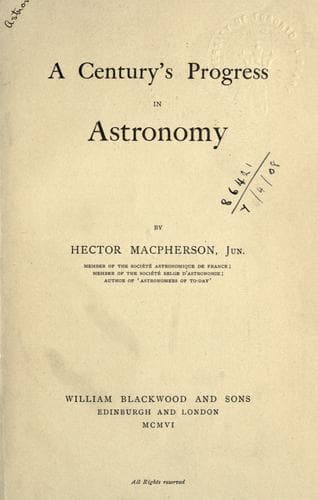
A Century's Progress in AstronomyMacpherson, Hector
History
A Century's Progress in Astronomy
Macpherson, Hector
Astronomy -- History
It is somewhat remarkable that the one celestial body which Herschel
neglected was our satellite, the Moon; and it is also remarkable that
the Moon was for many years the chief object of study of his
contemporary astronomer, _Johann Hieronymus Schröter_ (1745-1816). Born
at Erfurt, near Hanover, on August 30, 1745, Johann Hieronymus Schröter
was originally intended for the study of law, for which he was sent to
the University of Göttingen. At the same time he studied mathematics,
and particularly astronomy, under the mathematician, Kaestner of
Göttingen. Deeply interested in music, he became acquainted with the
Herschel family, and, inspired by William Herschel’s example, determined
to study the heavens. In 1779 he became the possessor of a small
achromatic refractor, and commenced to observe the Sun and Moon. In 1778
he entered the legal profession at Hanover, and four years later he was
appointed “oberamtmann” or Chief Magistrate of Lilienthal—“the Vale of
Lilies”—in the Duchy of Bremen. At Lilienthal Schröter erected a small
observatory, and acquired in 1785 one of Herschel’s 7-foot reflectors.
In 1792 the astronomer superintended the construction of a 13-foot
reflector, made by Schrader of Kiel, who transferred his workshop to
Lilienthal. With these instruments the great work of Schröter was
accomplished.
Schröter directed his powers of observation to the study of the Moon. He
originated the study of the surface of the Moon, and founded the branch
of astronomy known as selenography, or the study of the Moon’s surface.
The foundations of this branch were laid in 1791 with the publication of
Schröter’s ‘Seleno-topographische Fragmente’. The astronomer determined
to make a comparative study of the surface of our satellite, and before
1801 discovered eleven “rills” or clefts on the Moon’s surface, and
recognised a large number of craters. He likewise believed that he had
seen a lunar atmosphere, an observation of which was made by him in
February 1792. Schröter seems never to have doubted what Herschel and
his contemporaries believed—that the Moon was a living world with
volcanoes in active eruption, surrounded by an atmosphere, and inhabited
by beings like ourselves. Unfortunately, Schröter was not good at making
drawings of what he saw; nevertheless, he accomplished a vast amount of
work. In the little observatory at Lilienthal the foundations were laid
of the comparative study of the surface of the Moon.
Public-domain text, read in full here on John Shaqi.
Reviews
Reviews
No reviews yet
Be the first to share your thoughts on this work.
Join the Discussion
Join the discussion
Sign in to leave a comment or review.
Sign InorCreate an account