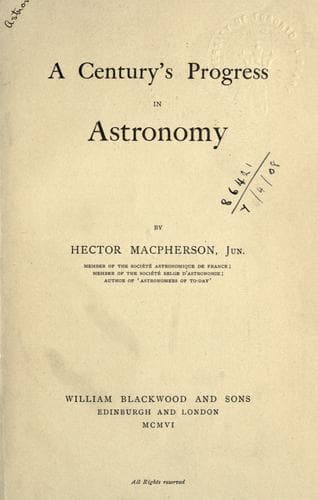
A Century's Progress in AstronomyMacpherson, Hector
History
A Century's Progress in Astronomy
Macpherson, Hector
Astronomy -- History
Mädler’s dogmatic assertion that the Moon was entirely a dead world was
generally believed until Schmidt made observations to the contrary. From
1837 to 1866 the popular opinion was that our satellite was an
absolutely dead world. Consequently there was little progress in lunar
astronomy during those thirty years. Although Mädler’s view was much
nearer the truth than the opinions of his predecessors, it was also too
positive. His confident assertion, which was received without
hesitation, was never questioned until Schmidt came upon the scene. To
Schmidt the Moon was not entirely dead, and it was he who brought
forward indisputable evidence as to the existence of changes on its
surface. In October 1866 he announced that the crater Linné had lost all
appearance of such, and that it had become entirely effaced. Lohrmann
and Mädler had observed it under a totally different aspect, as also had
Schmidt himself from 1840 to 1843. There was great excitement in the
astronomical world on Schmidt’s announcement, and many astronomers
denied the change, although Schmidt’s observation was confirmed by
Secchi and Webb. The evidence in favour of it preponderated, and very
few observers now consider the Moon’s surface to be absolutely
changeless.
In 1865 Schmidt had begun to arrange his observations on the Moon into
the form of a chart. At first he decided to have a chart of six feet
diameter, divided, like that of Mädler, into four sections. But in April
1868, on making an estimate of the value of such a chart, he was
dissatisfied, and determined to construct a map of the same size divided
into twenty-five sections instead of four. He began the work in 1868,
and after six years the great map was completed. After some delay the
German Government undertook to issue the chart at their expense, and it
was published in 1879, after fourteen years of preparation. It contained
no fewer than 30,000 objects, and its completed diameter was six feet
three inches—more than double the size of any previous map of the Moon.
Indeed, it was probably the greatest contribution ever made to lunar
astronomy. Schmidt lived only a few years after the publication of his
great chart. He died at Athens, in his fifty-ninth year, February 8,
1884.
Public-domain text, read in full here on John Shaqi.
Reviews
Reviews
No reviews yet
Be the first to share your thoughts on this work.
Join the Discussion
Join the discussion
Sign in to leave a comment or review.
Sign InorCreate an account