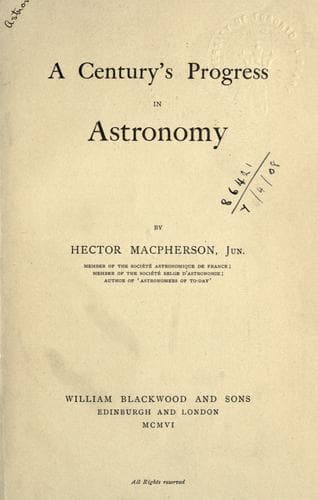
A Century's Progress in AstronomyMacpherson, Hector
History
A Century's Progress in Astronomy
Macpherson, Hector
Astronomy -- History
The first successful attempt to measure the heating power of moonlight
was made in 1846 on Mount Vesuvius by _Melloni_, an Italian physicist,
whose results were confirmed four years later by _Zantedeschi_, another
Italian. The most important work in this direction was accomplished by
the present _Earl of Rosse_ (born in 1840), who in the years 1869-72
believed himself to have measured the lunar heat; but these conclusions
were not altogether confirmed by the observations of Dr _Otto
Boeddicker_ (Lord Rosse’s astronomer), during the total lunar eclipse of
October 4, 1884. Further investigations on this subject were afterwards
made by _Samuel Pierpont Langley_ (1834-1906), of Alleghany, and by his
assistant, _Frank Very_.
The motion of the Moon and its perturbations were made the subject of
deep study by the famous _Pierre Simon Laplace_ (1749-1827), the
contemporary of Herschel, and the worthy successor of Newton. He devoted
much attention to the secular acceleration of the Moon’s mean motion, a
problem which had baffled the greatest mathematicians. After a profound
discussion he found, in 1787, that the average distance of the Earth and
Moon from the Sun had been slowly increasing for several centuries, the
result being an increase in the Moon’s velocity. In the third volume of
the ‘Mécanique Céleste’ Laplace worked out the lunar theory in great
detail, although he calculated no lunar tables. After his death the
subject was taken up by _Charles Theodore Damoiseau_ (1768-1846), and
the most important advance was made by _Giovanni Antonio Amadeo Plana_
(1781-1864), the director of the Turin Observatory, who published in
1832 a very complete lunar theory. The work of Plana was followed by
that of _Peter Andreas Hansen_ (1795-1874), whose lunar tables were used
for the Nautical Almanac, and whom Professor Simon Newcomb considers to
be the greatest master of celestial mechanics since Laplace. The theory
of the Moon’s motion was worked out in detail by the famous astronomer
_Charles Eugene Delaunay_ (1816-1872), who from 1870 till 1872 occupied
the post of director of the Paris Observatory. Delaunay was about to
work out the lunar tables when, in 1872, he was accidentally drowned by
the capsizing of a pleasure-boat at Cherbourg. The work accomplished in
this direction by _Simon Newcomb_ (born 1835) is of great importance,
particularly in his correction of Hansen’s tables. _John Couch Adams_
(1819-1892), one of the discoverers of Neptune, while at work on the
lunar theory, had occasion to correct Laplace’s supposed solution of the
acceleration of the lunar motion. On going over the calculation Adams
found that several quantities, omitted by Laplace as unimportant, showed
that the Moon has a minute increase of speed for which the theory of
gravitation will not account,—a conclusion opposed by Plana, Hansen, and
Pontécoulant, but fully confirmed by Delaunay. Delaunay suggested in
1865 that the minute apparent increase was due to the retardation of the
Public-domain text, read in full here on John Shaqi.
Reviews
Reviews
No reviews yet
Be the first to share your thoughts on this work.
Join the Discussion
Join the discussion
Sign in to leave a comment or review.
Sign InorCreate an account