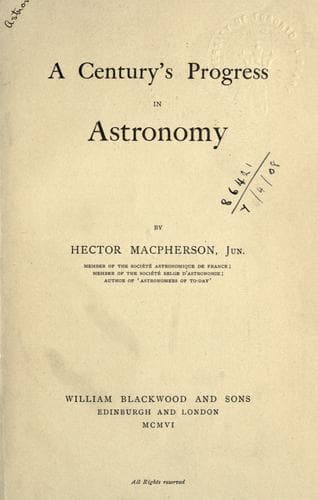
A Century's Progress in AstronomyMacpherson, Hector
History
A Century's Progress in Astronomy
Macpherson, Hector
Astronomy -- History
The spectrum of Mars was first examined by Huggins in 1867. He found
distinct traces of water-vapour, and this was confirmed by Vogel in
1872, and by Maunder some years later. In 1894, however, _William
Wallace Campbell_ (born 1862), the American astronomer, observing from
the Lick Observatory, California, was unable to detect the slightest
difference between the spectra of Mars and the Moon, indicating that
Mars had no appreciable atmosphere; and from this he deduced that the
Martian polar caps could not be composed of snow and ice, but of frozen
carbonic acid gas. In 1895, however, Vogel confirmed his previous
observations, and reaffirmed the presence of water-vapour in the Martian
atmosphere.
During the opposition of 1830, Mädler undertook an extensive search for
a Martian satellite, but was unsuccessful. In 1862 the search was
resumed by _Heinrich Louis D’Arrest_ (1822-1875), the famous German
observer, who was also unsuccessful. Accordingly the red planet was
referred to by Tennyson as the “moonless Mars.” In 1877 the search was
taken up by _Asaph Hall_, the self-made American astronomer, born at
Goshen, Connecticut, in 1829, and employed from 1862 to 1891 at the
Naval Observatory, Washington. During the famous opposition of August
1877, favoured by the great 26-inch refractor, he succeeded in
discovering two very small satellites of Mars, to which he gave the
names of Phobos and Deimos. He determined the time of revolution of
Phobos at 7 hours 39 minutes, and that of Deimos at 30 hours 17
minutes,—Phobos revolving round Mars more than three times for one
rotation of the planet on its axis. These two satellites are very small,
not more than thirty miles in diameter. After Hall’s successful search,
photographs were exposed at the Paris Observatory for other Martian
satellites, but none was discovered. No further moons have been found
belonging to the red planet, nor is it likely that any further
satellites of Mars are in existence.
Public-domain text, read in full here on John Shaqi.
Reviews
Reviews
No reviews yet
Be the first to share your thoughts on this work.
Join the Discussion
Join the discussion
Sign in to leave a comment or review.
Sign InorCreate an account