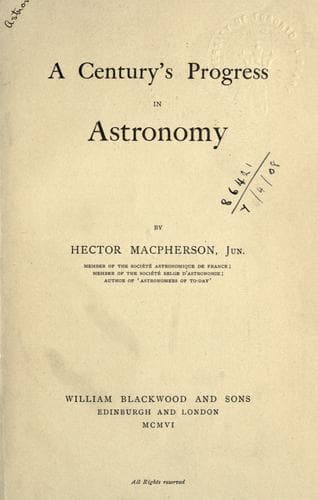
A Century's Progress in AstronomyMacpherson, Hector
History
A Century's Progress in Astronomy
Macpherson, Hector
Astronomy -- History
On March 28, 1802, while observing Ceres from his house at Bremen,
Olbers was struck by the presence of a strange object near the path of
the planet. At first he supposed it to be a variable star at maximum
brilliance, but a few hours showed him that it was in motion, and was
therefore another planet. He named it Pallas, and propounded the theory
that the two “Asteroids”—so named by Herschel—were fragments of a
trans-Martian planet, which, through some accident, had been shattered
to pieces in the remote past. Olbers urged the necessity of searching
for more small planets. His advice was taken. In 1804 _Karl Ludwig
Harding_ (1765-1834), Schröter’s assistant, discovered Juno, and Olbers
himself detected Vesta, March 29, 1807.
After 1816 the search was relinquished, as no more planets were
discovered. In 1830, however, a German amateur, _Karl Ludwig Hencke_
(1793-1866), ex-postmaster of Driessen, commenced a search for new
planets, which was rewarded, after fifteen years, by the discovery of
Astræa, December 8, 1845. On July 1, 1847, he made another discovery,
that of Hebe. A few weeks later, _John Russell Hind_ (1823-1895), the
English astronomer, discovered Iris. Since 1847 not a year has passed
without one or more planets being found, sometimes as many as twenty
being discovered in a single year. Some astronomers have made the search
for asteroids their chief business. The principal asteroid discoverers
have been _Christian H. F. Peters_ (1813-1890), Henri Perrotin, _Paul
Henry_ (1848-1905), _Prosper Henry_ (1849-1903), James Watson, _Robert
Luther_ (1822-1900), _Johann Palisa_ (born 1848), and _Max Wolf_ (born
1863).
In 1891 a new impulse was given to asteroid study by the application of
photography by Max Wolf to the discovery of the minor planets. It
occurred to Wolf that the asteroid would be represented on the plate by
a trail, caused by its motion during the time of exposure; and assisted
by _Arnold Schwassmann_ (born 1870), _Luigi Carnera_ (born 1875), and
others, Wolf has discovered over a hundred asteroids, and he has the
whole field of asteroid hunting to himself. Few minor planets are now
discovered by the older method. In 1901 Wolf invented his new instrument
of research, the stereo-comparator, which, on the principle of the
old-fashioned stereoscope, represents the planetary bodies as suspended
in space far in front of the stars. In this way this ingenious
astronomer has been enabled to discover asteroids at the first glance:
year by year fresh discoveries are announced from the Heidelberg
Observatory, until more than five hundred asteroids are now known.
Public-domain text, read in full here on John Shaqi.
Reviews
Reviews
No reviews yet
Be the first to share your thoughts on this work.
Join the Discussion
Join the discussion
Sign in to leave a comment or review.
Sign InorCreate an account