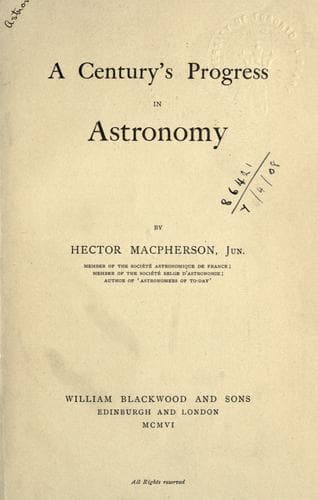
A Century's Progress in AstronomyMacpherson, Hector
History
A Century's Progress in Astronomy
Macpherson, Hector
Astronomy -- History
The study of the globe of Saturn has made less progress than that of the
rings. The surface of the planet had been known since before the time of
Herschel to be covered with belts, but as spots seldom appear on Saturn,
only one determination of the rotation period had been made, that by
Herschel. Much interest was aroused, therefore, by the discovery, by
Hall, at Washington, on December 7, 1876, of a bright equatorial spot.
Hall studied this spot during sixty rotations of the planet, determining
the period as 10 hours 14 minutes 24 seconds. This was confirmed by
Denning in 1891, and by _Stanley Williams_, an English observer, in the
same year. On June 16, 1903, Barnard, at the Yerkes Observatory,
discovered a bright spot, from which he deduced a rotation period of 10
hours 39 minutes,—a period considerably longer than that found by Hall.
In the same year various spots on Saturn were observed by Denning, who
found a period of 10 hours 37 minutes 56·4 seconds, and at Barcelona by
_José Comas Sola_, now director of the Observatory there, who may be
considered Spain’s leading astronomer. The result of these observations
has been to show that the spots on Saturn have probably a proper motion
of their own, apart from the rotation of the planet. As to the spectrum
of Saturn, little has been learned. It closely resembles that of
Jupiter. In 1867 Janssen, observing from the summit of Mount Etna, found
traces of aqueous vapour in the planet’s atmosphere.
In the chapters on Herschel we have seen that he discovered the sixth
and seventh satellites of Saturn. The next discovery was made on
September 19, 1848, by W. C. Bond, at Harvard, Massachusetts, and
independently by _William Lassell_ (1799-1880), at Starfield, near
Liverpool. The new satellite received the name of Hyperion, and was
found to be situated at a distance of about 946,000 miles from Saturn.
Its small size led Sir John Herschel to the idea that it might be an
asteroidal satellite. Fifty years elapsed before another satellite of
Saturn was discovered. In 1888 W. H. Pickering commenced a photographic
search for new satellites of the planet. At last, on developing some
photographs of Saturn, taken on August 16, 17, and 18, 1898, he found
traces of a new satellite which he named “Phœbe.” But, as the satellite
was not seen or photographed again for some years, many astronomers were
sceptical as to its existence. However, photographs taken in 1900, 1901,
and 1902 revealed the satellite, which was again photographed in 1904,
and seen visually by Barnard in the same year with the 40-inch Yerkes
telescope. At that time the discoverer brought out the amazing fact that
the motion of the satellite is retrograde—a fact which he attempts to
explain by a new theory of the former rotation of Saturn. He likewise
demonstrated that its distance from Saturn varied from 6,120,000 to
9,740,000 miles. Early in 1905 Pickering announced the discovery of a
Public-domain text, read in full here on John Shaqi.
Reviews
Reviews
No reviews yet
Be the first to share your thoughts on this work.
Join the Discussion
Join the discussion
Sign in to leave a comment or review.
Sign InorCreate an account