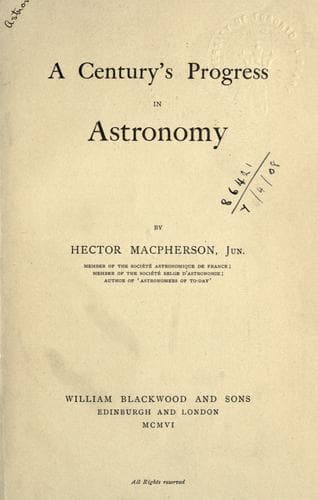
A Century's Progress in AstronomyMacpherson, Hector
History
A Century's Progress in Astronomy
Macpherson, Hector
Astronomy -- History
In the mind of Herschel imagination and observation were marvellously
blended. He was a philosophical astronomer. Although his imagination was
a very vivid one he did not allow his fancies to run away with him, as
Kepler sometimes did: on the other hand, he did not, like Flamsteed,
refrain from speculating altogether. “We ought,” he wrote in 1785, “to
avoid two opposite extremes. If we indulge a fanciful imagination, and
build worlds of our own, we must not wonder at our going wide from the
path of truth and nature. On the other hand, if we add observation to
observation, without attempting to draw not only certain conclusions but
also conjectural views from them, we offend against the very end for
which only observations ought to be made.”
These characteristics—the lightness with which he held his theories, his
vivid imagination, and his philosophical reasoning—are the secrets of
Herschel’s success as an astronomer. Nearly all his ideas and
speculations have been confirmed. As Arago has said, “We cannot but feel
a deep reverence for that powerful genius that has scarcely ever erred.”
Herschel, like all other great students of Nature, was deeply religious.
He could not observe the heavens without feeling awed at the marvels
which his telescopes revealed. In his own words, “It is surely a very
laudable thing to receive instruction from the Great Workmaster of
Nature.”
Friedrich Wilhelm Herschel, born in Hanover on November 15, 1738, was
the fourth child of Isaac Herschel, an oboist in the band of the
Hanoverian Guard. Isaac Herschel, a native of Dresden, was an
accomplished musician, and all his children, ten in number, inherited
his talent. Of these ten, six survived, and only two became famous.
These were William, the great astronomer, and his sister Caroline (born
on March 16, 1750), who became a student of the heavens only second to
her brother.
At the garrison school in Hanover, where the Herschels were educated,
William Herschel showed intense love and aptitude for learning, and was
more diligent and persevering than his brother Jacob, his senior by four
years. In 1753 he became oboist in the band of the Hanoverian Guard in
which his father was now bandmaster. In her valuable memoirs, his sister
relates that her father was very interested in astronomy, and that he
taught his children the names of the constellations. William became
devoted to the science, and constructed a small celestial globe on which
equator and ecliptic were engraved. But his studies were much hampered.
His mother had a great dislike to learning: she had no sympathy with
aspirations, and tried to prevent her children becoming well educated.
Above all, the Hanoverian Guard was ordered to England in 1755, when a
French invasion was feared, and to that country Herschel proceeded,
along with his father and brother.
Public-domain text, read in full here on John Shaqi.
Reviews
Reviews
No reviews yet
Be the first to share your thoughts on this work.
Join the Discussion
Join the discussion
Sign in to leave a comment or review.
Sign InorCreate an account