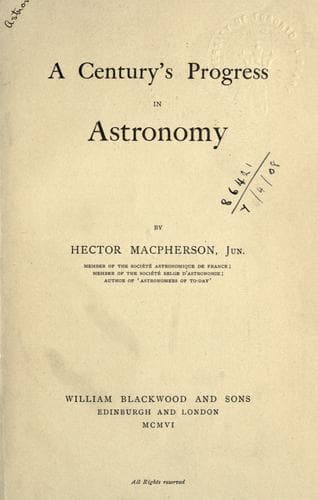
A Century's Progress in AstronomyMacpherson, Hector
History
A Century's Progress in Astronomy
Macpherson, Hector
Astronomy -- History
The theory of the actual disintegration of comets was enunciated by
Schiaparelli in 1873, and developed in his work ‘Le Stelle Cadenti.’ He
was led to regard comets as cosmical clouds formed in space by “the
local concentration of celestial matter.” He then remarks that a
cosmical cloud seldom penetrates to the interior of the Solar System,
“unless it has been transformed into a parabolic current,” which may
occupy years, or centuries, in passing its perihelion, “forming in space
a river, whose transverse dimensions are very small with respect to its
length: of such currents, those which are encountered by the earth in
its annual motion are rendered visible to us under the form of showers
of meteors diverging from a certain radiant.”
Schiaparelli next pointed out that when the current of meteors
encounters a planet, the resulting perturbations cause some of the
meteoric bodies to move in separate orbits, forming the bolides and
aerolites which fall from the sky at intervals. “The term _falling
stars_” he says, “expresses simply and precisely the truth respecting
them. These bodies have the same relation to comets that the small
planets between Mars and Jupiter have to the larger planets.” In the
third chapter of his ‘Le Stelle Cadenti’ he explicitly states that “the
meteoric currents are the products of the dissolution of comets, and
consist of minute particles which certain comets have abandoned along
their orbits, by reason of the disintegrating force which the Sun and
planets exert on the rare materials of which they are composed.”
Public-domain text, read in full here on John Shaqi.
Reviews
Reviews
No reviews yet
Be the first to share your thoughts on this work.
Elsewhere in the archive
Join the Discussion
Join the discussion
Sign in to leave a comment or review.
Sign InorCreate an account