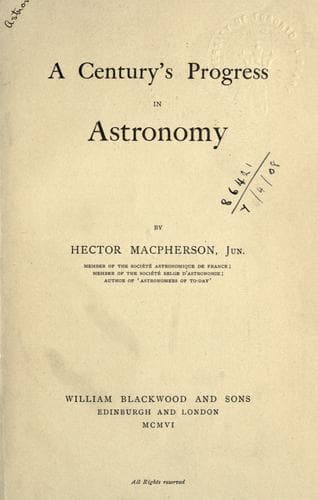
A Century's Progress in AstronomyMacpherson, Hector
History
A Century's Progress in Astronomy
Macpherson, Hector
Astronomy -- History
In 1878 _Alexander Stewart Herschel_ (born 1836), son of Sir John
Herschel, and a famous meteoric observer, published a list of known or
suspected coincidences of meteoric and cometary orbits, amounting to
seventy-six. Meanwhile much progress has since been made in the
observation of meteoric showers and the determination of their radiant
points. In this branch of astronomy, by far the greatest name is that of
William Frederick Denning, the self-made English astronomer. Born at
Redpost, in Somerset, in 1848, his career of meteoric observation
commenced in 1866. For the past forty years he has attentively devoted
himself to the observation of meteors. From 1872 to 1903 he determined
the radiant points of no fewer than 1179 meteoric showers. In addition
to this, he published, in 1899, a catalogue of meteoric radiants,
containing 4367; and he has carefully studied the remarkable objects
known as fireballs or “sporadic meteors.” He has occasionally been able
to trace a connection between fireballs and weak meteoric showers, but
he concludes that they “must either be merely single sporadic bodies, or
else the survivors of some meteor group, nearly exhausted by the waste
of its material during many past ages.” All of Denning’s meteoric work
has been done in his spare time, for it must be borne in mind that he
pursues the profession of accountant in Bristol, and that only his
leisure hours have been devoted to the science of astronomy. His
researches have been entirely conducted with the unaided eye. His only
instrument is a perfectly straight wand, which he uses as a help and
corrective to the eye in ascribing the paths of the meteors. Thanks to
the laborious work of this able English astronomer, the observation of
meteors is now a _scientific_ branch of astronomy. In the words of
Maunder, “for six thousand years men stared at meteors and learned
nothing, for sixty years they have studied them and learned much, and
half of what we know has been taught us in half that time by the efforts
of a single observer.”
Further meteoric showers from Biela’s comet were seen in 1885 and 1892.
The Leonid shower was confidently predicted for 1899, in accordance with
the thirty-three-year period, but the great display did not come off,
either in 1899 or 1900. In 1901 there was a certain weak shower observed
in America; and similar displays took place in 1903 and 1904. Many
explanations have been given as to the failure of the shower, the most
probable idea being that the attraction of Jupiter diverted the meteors
from their course.
Public-domain text, read in full here on John Shaqi.
Reviews
Reviews
No reviews yet
Be the first to share your thoughts on this work.
Elsewhere in the archive
Join the Discussion
Join the discussion
Sign in to leave a comment or review.
Sign InorCreate an account