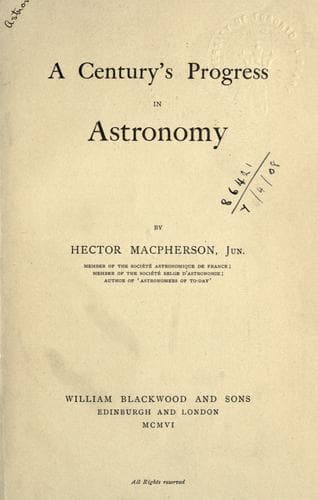
A Century's Progress in AstronomyMacpherson, Hector
History
A Century's Progress in Astronomy
Macpherson, Hector
Astronomy -- History
When the existence of aerolites as celestial bodies was first
recognised, Laplace suggested that they had been ejected from volcanoes
on the Moon. This theory, although supported by Olbers and other
astronomers, was soon rejected. Next, it was suggested that they were
ejected from the Sun, and Proctor believed them to come from the giant
planets. A very detailed discussion of the subject is to be found in
Ball’s ‘Story of the Heavens’ (1886), in which he expresses views in
harmony with those of the Austrian physicist Tschermak. Ball
demonstrated that the meteors which fall to the Earth cannot have come
from any other planet, nor from the Sun. Accordingly, he concluded that
they were originally ejected by the volcanoes of the Earth many ages
ago, when they were active enough to throw up pieces of matter with a
velocity great enough to carry them away from the Earth altogether. Such
meteors would, however, intersect the terrestrial orbit at each
revolution.
The alternative theory to this, supported by Schiaparelli and Lockyer,
is that the aerolites are merely larger members of the meteor-swarms,
which have been deflected from their paths. The chief objection to this
theory is the absence of connection between the meteoric showers and the
falls of aerolites and bolides. Only on one occasion was a meteoric
stone observed to fall during a shower. On November 27, 1885, during the
shower of Andromedid meteors from Biela’s comet, a large bolide,
weighing more than eight pounds, fell at Mazapil, in Mexico. This,
however, was the only case hitherto observed; and it may have been
merely a coincidence.
CHAPTER IX.
THE STARS.
The most remarkable progress in astronomy during the past century has
been in the department of sidereal science, or the study of the Suns of
space, observed for their own sakes, and not merely for the purpose of
determining the positions of the Sun and Moon, and to assist navigation.
Thanks to Herschel, the nineteenth century witnessed the steady
development of stellar astronomy, combined with many important
discoveries and investigations.
Public-domain text, read in full here on John Shaqi.
Reviews
Reviews
No reviews yet
Be the first to share your thoughts on this work.
Elsewhere in the archive
Join the Discussion
Join the discussion
Sign in to leave a comment or review.
Sign InorCreate an account