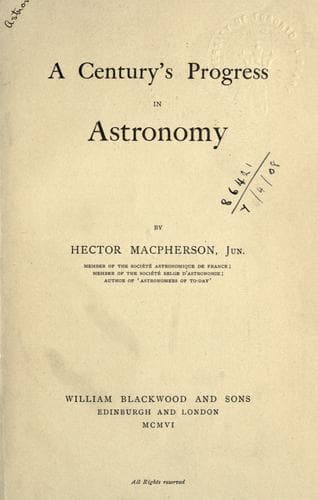
A Century's Progress in AstronomyMacpherson, Hector
History
A Century's Progress in Astronomy
Macpherson, Hector
Astronomy -- History
The one pre-Herschelian problem in sidereal astronomy was the distance
of the stars. Owing to its bearing on the Copernican theory, the problem
was attacked by the astronomers of the seventeenth and eighteenth
centuries. Herschel made numerous attempts to detect the parallax of the
brighter stars, but failed. Meanwhile there had been many illusions.
Piazzi believed that his instruments—which in reality were worn out and
unfit for use—had revealed parallaxes in Sirius, Aldebaran, Procyon, and
Vega; Calandrelli, another Italian, and _John Brinkley_ (1763-1835),
Astronomer-Royal of Ireland, were similarly deluded; and in 1821 it was
shown by _Friedrich Georg Wilhelm Struve_ (1793-1864), the great German
astronomer, that no instruments then in use could possibly be successful
in measuring the stellar parallax. A few years later, however,
Fraunhofer brought the refractor to a degree of perfection surpassing
all previous efforts. In 1829 he mounted for the observatory at
Königsberg a heliometer, the object-glass of which was divided in two,
and capable of very accurate measurements. This heliometer eventually
revealed the parallax of the stars in the able hands of Friedrich
Wilhelm Bessel.
Friedrich Wilhelm Bessel was born at Minden, on the Weser, south-west of
Hanover, on July 22, 1784. His father was an obscure Government
official, unable to provide a university education for his son. Bessel’s
love of figures, together with an aversion to Latin, led him to pursue a
commercial career. At the age of fourteen, therefore, he entered as an
apprenticed clerk the business of Kuhlenkamp & Sons, in Bremen. He was
not content, however, to remain in that humble position. His great
ambition was to become supercargo on one of the trading expeditions sent
to China; and so he learned English, Spanish, and geography. But he
never became a supercargo. In order to be fully equipped for such a
position, he determined to learn how to take observations at sea, and
his acquaintance with observation aroused a desire to study astronomy.
He constructed for himself a sextant, and by means of this, along with a
common clock, he determined the longitude of Bremen.
Such enthusiasm could not be long without its reward. For several years
Bessel remained a clerk, and the hours devoted to study were those
spared from sleep. He studied the works of Bode, Von Zach, Lalande, and
Laplace, and in two years was able to compute the orbits of comets by
means of mathematics. From some observations of Halley’s comet at its
appearance in 1607, Bessel calculated its orbit, and forwarded the
calculation to Olbers, then the greatest authority on cometary
astronomy. Olbers was delighted at this work, and he sent the results to
Von Zach, who published them. The self-taught young astronomer had
accomplished a piece of work which fifteen years before had taxed the
skill and patience of the French Academy of Sciences.
Public-domain text, read in full here on John Shaqi.
Reviews
Reviews
No reviews yet
Be the first to share your thoughts on this work.
Elsewhere in the archive
Join the Discussion
Join the discussion
Sign in to leave a comment or review.
Sign InorCreate an account