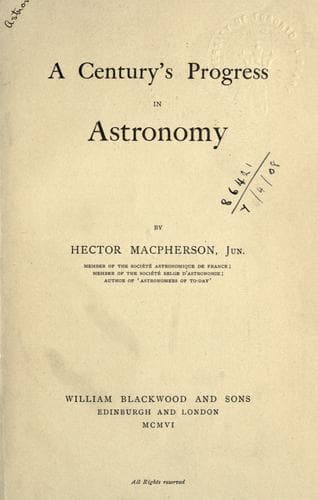
A Century's Progress in AstronomyMacpherson, Hector
History
A Century's Progress in Astronomy
Macpherson, Hector
Astronomy -- History
During a year’s work at the Cape, Henderson undertook a series of
observations on the bright southern star, α Centauri, with a view to
determining its parallax. These observations were made in 1832 and 1833,
but were not reduced until Henderson’s return to Scotland. At length, on
January 3, 1839, he announced to the Royal Astronomical Society that he
had succeeded in measuring the parallax of α Centauri, which he
determined as about one second of arc, corresponding to a distance of
about twenty billions of miles. This result was confirmed by the
observations of _Thomas Maclear_ (1794-1879), his successor at the Cape,
and by those of later observers, notably Sir David Gill, who has reduced
the parallax to 0·75″.
Other determinations of stellar parallax, some genuine and others
illusory, were made soon after these successful observations. C. A. F.
Peters and Otto Struve at Pulkowa were among the most famous
parallax-hunters in the middle of the century. One of the most
successful searchers after parallax was the German astronomer _Friedrich
Brünnow_ (1821-1891), who was employed from 1865 to 1874 as
Astronomer-Royal of Ireland. He determined the parallax of Vega as
0·13″, and this was confirmed in 1886 by Hall at Washington: while he
measured the parallax of the star Groombridge 1830, which turned out to
be 0·09″. He resigned his post in 1874, and his successor at Dublin
Observatory proved to be his successor also in this branch of astronomy.
_Robert Stawell Ball_, born in Dublin in 1840, was astronomer to Lord
Rosse in 1865 and 1866, and became in 1874 Astronomer-Royal of Ireland
in succession to Brünnow, a position which he filled until his
appointment in 1892 as Professor of Astronomy at Cambridge, and director
of the observatory there. During his term of office in Dublin he
undertook, in 1881, a “sweeping search” for large parallaxes, thereby
disproving certain ideas as to the proximity to the Earth of red and
temporary stars; while he also determined the parallax of the star 1618
Groombridge.
Public-domain text, read in full here on John Shaqi.
Reviews
Reviews
No reviews yet
Be the first to share your thoughts on this work.
Elsewhere in the archive
Join the Discussion
Join the discussion
Sign in to leave a comment or review.
Sign InorCreate an account