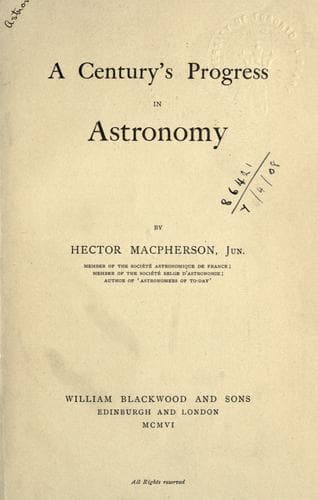
A Century's Progress in AstronomyMacpherson, Hector
History
A Century's Progress in Astronomy
Macpherson, Hector
Astronomy -- History
In 1805, Harding, Schröter’s assistant at Lilienthal, resigned his
position for a more promising one at Göttingen. Olbers procured for
Bessel the offer of the vacant post, which the latter accepted. At
Lilienthal Bessel received his training as a practical astronomer. He
remained in Schröter’s observatory until 1809. Although only twenty-five
years of age, he had become so well known in Germany that in that year
he was appointed Professor of Astronomy in the University of Königsberg,
and was chosen to superintend the erection of the new observatory there.
Within a few years a clerk in a commercial office had worked his way
from obscurity to fame.
In 1813 the Königsberg Observatory was completed, and here Bessel worked
for thirty-three years, until his death, on March 17, 1846. It was only
about ten years before his death that he commenced his search for the
stellar parallax, with the aid of Fraunhofer’s magnificent heliometer.
He determined to make a series of measures on a small double star of the
fifth magnitude in the constellation Cygnus, named 61 Cygni, the large
proper motion of which led him to suspect its proximity to the Solar
System. From August 1837 to September 1838 he made observations on 61
Cygni, and he found that there was an annual displacement which could
only be attributed to parallax. In order to have no mistake, he made
another year’s observations, which confirmed the results he arrived at
previously, and all doubt was removed by a third series. The resulting
parallax was 0·3483″, corresponding to a distance of 600,000 times the
Earth’s distance from the Sun. This was confirmed some years later by C.
A. F. Peters at Pulkowa, and still later by Otto Struve, who estimated
the distance at forty billions of miles. Meanwhile, F. G. W. Struve,
working at Pulkowa, found a parallax of 0·2613″ for Vega, but this was
afterwards found to be considerably in error. Accordingly, Struve does
not rank with Bessel as a successful measurer of star-distance. But
independently of Bessel, another accurate measure had been made by
_Thomas Henderson_, the great Scottish astronomer.
Born in Dundee in 1798, Thomas Henderson was the youngest of five
children of a hard-working tradesman. After education in his native town
he went to Edinburgh, where he worked for years as an advocate’s clerk,
pursuing studies in astronomy as a recreation from his boyhood. In 1831
he had become so well known, that he received the appointment of
Astronomer-Royal at the new observatory at the Cape of Good Hope. But
the climate of South Africa did not suit his health, and after a year he
returned to Scotland. In 1834 he became Professor of Astronomy in the
University of Edinburgh, and Astronomer-Royal of Scotland, which
position he held till his death on November 23, 1844, at the early age
of forty-six.
Public-domain text, read in full here on John Shaqi.
Reviews
Reviews
No reviews yet
Be the first to share your thoughts on this work.
Elsewhere in the archive
Join the Discussion
Join the discussion
Sign in to leave a comment or review.
Sign InorCreate an account