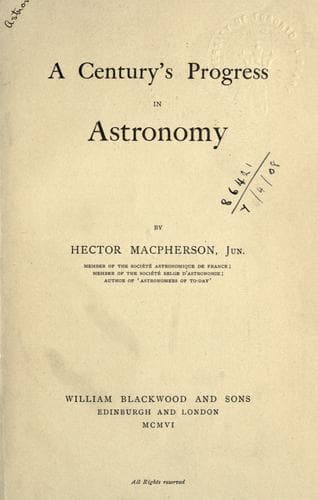
A Century's Progress in AstronomyMacpherson, Hector
History
A Century's Progress in Astronomy
Macpherson, Hector
Astronomy -- History
Closely allied to the question of parallax is the determination of the
exact positions of the stars and the formation of star-catalogues. In
this branch, too, much is due to the genius of Bessel. The observations
of Bradley at Greenwich from 1750 to 1762 were reduced by Bessel into
the form of a catalogue, which was published in 1818, with the title of
‘Fundamenta Astronomiæ.’ During the years 1821 to 1823 Bessel took
75,011 observations, by which he brought up the number of accurately
known stars to 50,000. At the same time notable catalogues had been
constructed, particularly by the English astronomer, _Francis Baily_
(1774-1844), and by _Giovanni Santini_ (1786-1877), director of the
observatory at Padua; but Bessel’s successor in this branch of research
was _Friedrich Wilhelm August Argelander_ (1799-1875). In 1821 he became
assistant to Bessel at Königsberg, in 1823 director of the Observatory
at Abo, in Finland, and in 1837 of that at Bonn. Here he commenced in
1852 the great ‘Bonn Durchmusterung,’ a catalogue and atlas of 324,198
stars visible in the northern hemisphere. The great catalogue was
published in 1863. After Argelander’s death it was extended so as to
include 133,659 stars in the southern hemisphere, by his assistant
_Eduard Schönfeld_ (1828-1891), who succeeded him in 1875 as director of
Bonn Observatory, where he died in 1891. Meanwhile a greater undertaking
was commenced in 1865 by the Astronomische Gesellschaft. This was the
co-operation of thirteen observatories in Europe and America for the
exact determination of the places of 100,000 of Argelander’s stars.
In the southern hemisphere, working at Cordova in Argentina, was the
great American astronomer, _Gould_, whose ‘Uranometria Argentina,’
published in 1879, gives the magnitudes of 8198 stars, and whose
Argentine General Catalogue, containing reference of 32,448 stars, was
published in 1886. The late Radcliffe observer, Stone, published a
useful catalogue in 1880 from his observations at the Cape.
The application of photography to the work of star-charting dates from
1882, when Gill photographed the comet of 1882, and was struck with the
distinctness of the stars on the background. For some time he had
contemplated the extension of the ‘Durchmusterung,’ from the point where
Schönfeld left it, to the southern pole, and the idea struck him to
utilise photography for the purpose. In 1885, accordingly, Gill
commenced work, and in four years all the photographs were taken. The
reduction of the observations into the form of a catalogue was
spontaneously undertaken by the great Dutch astronomer, Kapteyn, who was
occupied with the work for fourteen years, until in 1900 the great
catalogue, known as the ‘Cape Photographic Durchmusterung,’ was
completed. Half a million stars are represented on the plates taken at
the Cape.
Public-domain text, read in full here on John Shaqi.
Reviews
Reviews
No reviews yet
Be the first to share your thoughts on this work.
Elsewhere in the archive
Join the Discussion
Join the discussion
Sign in to leave a comment or review.
Sign InorCreate an account