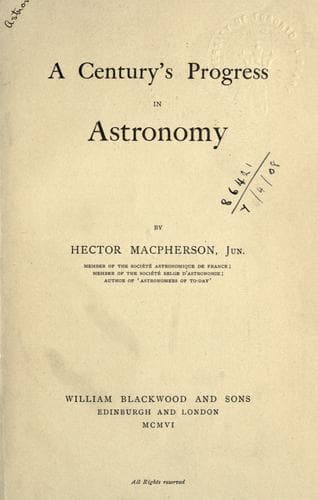
A Century's Progress in AstronomyMacpherson, Hector
History
A Century's Progress in Astronomy
Macpherson, Hector
Astronomy -- History
By the time the ‘Durchmusterung’ was completed, a greater undertaking
was in progress. Paul and Prosper Henry, astronomers at the Paris
Observatory, when engaged in continuing Chacornac’s ecliptic charts,
applied photography to their work, and found it very successful.
Accordingly Gill’s proposal, on June 4, 1886, of an International
Congress of Astronomers, to undertake a photographic survey of the
heavens, was enthusiastically received by the French astronomers. The
Congress met at Paris in 1887, under the presidentship of _Amédée
Mouchez_ (1821-1892), director of the Paris Observatory, fifty-six
astronomers of all nations being present. The Congress resolved to
construct a Photographic Chart, and a Catalogue, the former containing
twenty million stars, the latter a million and a quarter. Meetings were
held in Paris in 1891, 1893, 1896, and 1900 to superintend the progress
of the work, which is now (1906) well advanced towards completion.
A unique star catalogue is in course of preparation by the Scottish
astronomer, _William Peck_ (born 1862), astronomer to the City of
Edinburgh since 1889. Mr Peck’s catalogue is accompanied by a series of
charts. His star-magnitudes are those of all famous catalogues reduced
to a standard scale. This catalogue, the result of more than fifteen
years’ work, will be an important addition to the many valuable works of
the kind already in existence, and will further increase the already
great reputation of Scotsmen in practical astronomy.
The determination of the proper motions of the stars is another
important branch of practical astronomy in which much progress has been
made since the time of Herschel. Stars with much larger proper motions
than those of the first magnitude have been discovered. For many years
the small sixth-magnitude star in Ursa Major, 1830 Groombridge, was
supposed to be the swiftest of the stars, and was named by Newcomb the
“runaway star.” But in 1897, on examining the plates of the ‘Cape
Durchmusterung,’ Kapteyn discovered a still swifter star of the eighth
magnitude, situated in the southern constellation, Pictor. The rate of
its motion is over eight seconds of arc yearly; and an idea of the vast
distance of the stars may be obtained by the statement that it would
take 200 years for the star—known as Gould’s Cordova Zones, V Hour
243—to move over a space equal to the moon’s diameter. Important
observations have been made on the stellar motions, and on their bearing
on the structure of the Universe, by various astronomers, including J.
C. Kapteyn and _Ludwig Struve_ (born 1858), son of Otto Struve; but
these must be reserved for a later chapter.
Public-domain text, read in full here on John Shaqi.
Reviews
Reviews
No reviews yet
Be the first to share your thoughts on this work.
Elsewhere in the archive
Join the Discussion
Join the discussion
Sign in to leave a comment or review.
Sign InorCreate an account