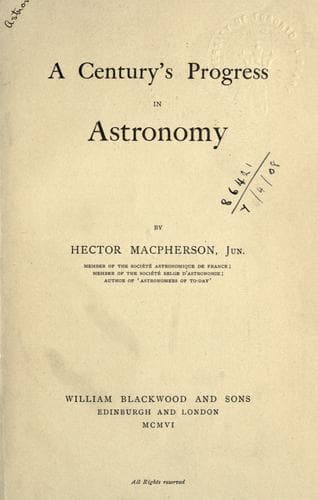
A Century's Progress in AstronomyMacpherson, Hector
History
A Century's Progress in Astronomy
Macpherson, Hector
Astronomy -- History
In 1863 Huggins made an attempt to photograph the spectra of the stars,
and, indeed, obtained prints of Sirius and Capella, but no lines were
visible in them. In 1874 Draper of New York obtained a photograph of the
spectrum of Vega, showing four lines. Two years later Huggins again
attacked the problem, and secured a photograph of the spectrum of Vega,
showing seven strong lines. In 1879 he was enabled to communicate
satisfactory results of his work to the Royal Society, and since then he
has secured many admirable representations. In 1899 the monumental work,
‘An Atlas of Representative Stellar Spectra,’ the joint work of Sir
William and Lady Huggins, was published.
In 1874 the German Government established at Potsdam the Astrophysical
Observatory, for the spectroscopic study of the Sun and stars. A
position on the staff was given to Hermann Carl Vogel, whose researches
in astronomical spectroscopy rank with those of Secchi and Huggins. Born
in Leipzig in 1842, he was from 1865 to 1869 employed in the Leipzig
Observatory. Called to Bothkamp as director in 1870, he resigned his
post in 1874 to accept a position on the staff at Potsdam Observatory.
In 1882 he became director of that Institution, which position he still
retains.
In 1874 Vogel revised Secchi’s classification of stellar spectra, and in
1895 he further improved on it. His classification improves rather than
supersedes the previous work of Secchi; nevertheless, he approached the
question from a different standpoint. Vogel concluded in 1874 that a
rational scheme of stellar classification “can only be arrived at by
proceeding from the standpoint that the phrase of development of the
particular body is, in general, mirrored in its spectrum.” Vogel divides
Secchi’s first type into three classes. In the first type, designated
I_a_,—represented by Sirius and Vega,—the metallic lines are “very faint
and fine,” and the hydrogen lines conspicuous. In I_b_ no hydrogen lines
are visible, while in I_c_ the hydrogen lines are bright. This class
includes the gaseous stars. In 1895, after the recognition of helium in
the stars by his assistant, Scheiner, Vogel separated the stars of class
I_b_ from the first type altogether. These stars are sometimes
designated as “Type O,” and sometimes as helium stars and Orion stars,
as the majority of the stars in Orion are of that type. The solar type
is divided into two classes, II_a_ being represented by the Sun,
Capella, and other well-known stars, while II_b_ includes the Wolf-Rayet
stars. Secchi’s third and fourth types are both classified by Vogel as
of the third type. These red stars were specially studied from 1878 to
1884 by Dunér at Lund. His results were published in a descriptive
catalogue which appeared at Stockholm in 1884. His researches related to
the spectra of 352 stars, 297 of Secchi’s third type and 55 of his
fourth. Dunér is perhaps the greatest authority on stars with banded
spectra.
Public-domain text, read in full here on John Shaqi.
Reviews
Reviews
No reviews yet
Be the first to share your thoughts on this work.
Elsewhere in the archive
Join the Discussion
Join the discussion
Sign in to leave a comment or review.
Sign InorCreate an account