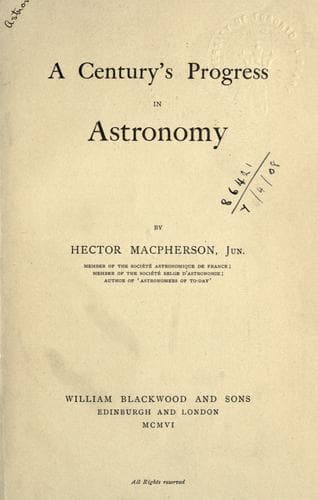
A Century's Progress in AstronomyMacpherson, Hector
History
A Century's Progress in Astronomy
Macpherson, Hector
Astronomy -- History
Angelo Secchi was born in 1818 at Reggio, in the Emilia. Educated in the
Collegio Romano, he was ordained priest in 1847, but his love of
science, and particularly astronomy, dates from the beginning of his
career. In 1849 he succeeded Di Vico as director of the Observatory of
the Collegio Romano. This post he filled with conspicuous ability for a
period of twenty-nine years, until his death on February 26, 1878. To
Secchi is due the credit of the first spectroscopic survey of the
heavens. He reviewed the spectra of 4000 stars, and classified them into
four distinct groups, which are recognised to this day. The first type
embraces over half of those which Secchi examined. This type is
represented by Sirius, Vega, Altair, and other bluish-white stars, and
is characterised by the intensity of the hydrogen lines. The second type
embraces the yellow stars, such as Capella, Arcturus, Aldebaran, Pollux,
and the Sun itself, and is known as the Solar type. The spectra of these
stars closely resemble that of the Sun, and are distinguished by
innumerable lines. Secchi’s third type, or red stars, represented by
Betelgeux, Antares, and others, are characterised by strong absorption
bands, and the spectra have been described as “fluted.” The third-type
stars are comparatively scarce compared with the first and second, and
the fourth is even less numerous. The fourth-type stars are also red
with broad absorption lines. To Secchi’s four types a fifth was added in
1867 by Wolf and Rayet of Paris Observatory—namely, the gaseous stars.
Secchi aimed at a comprehensive survey of the stellar spectra, and he
accomplished much valuable work. He did not devote his time to analysing
individual stars. This branch of study—analysis of spectra and the
determination of the elements in the stars—was undertaken by his
contemporary, William Huggins, one of the greatest astronomers whom
England has ever produced.
Born in London in 1824, William Huggins commenced his astronomical
researches at the age of twenty-eight. In 1856 he erected, at Tulse
Hill, London, an observatory which he equipped at great expense. He
commenced observations on the usual astronomical lines, taking times of
transits and making drawings of the surfaces of the planets. But he soon
tired of the routine of ordinary astronomical work, and on the
publication of Kirchhoff’s explanation of the Fraunhofer lines in the
solar spectrum, he commenced to investigate the spectra of the stars.
Having constructed a suitable spectroscope, he commenced observations in
1862 in conjunction with his friend, William Allen Miller, Professor of
Chemistry in London. He exhaustively investigated the two red stars,
Betelgeux and Aldebaran, ascertaining the existence in the former star
of sodium, iron, calcium, magnesium, and bismuth; and in the latter star
the same elements, with the addition of tellurium, antimony, and
mercury.
Public-domain text, read in full here on John Shaqi.
Reviews
Reviews
No reviews yet
Be the first to share your thoughts on this work.
Elsewhere in the archive
Join the Discussion
Join the discussion
Sign in to leave a comment or review.
Sign InorCreate an account