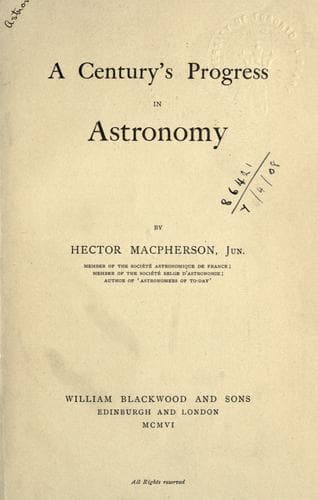
A Century's Progress in AstronomyMacpherson, Hector
History
A Century's Progress in Astronomy
Macpherson, Hector
Astronomy -- History
Born in Boston in 1846, Edward Charles Pickering was appointed in 1865
Instructor of mathematics in the Lawrence Scientific School at Harvard,
after a distinguished university career. In 1876 he succeeded Winlock as
director of the Harvard Observatory, and in the following year he
commenced his photometric studies. He invented an instrument named the
meridian photometer, with the aid of which he succeeded in determining,
in the years 1879 to 1882, the exact brilliance of 4260 stars to the
sixth magnitude between the north celestial pole and thirty degrees of
south declination. At a later date he devised a larger photometer, with
which he made over one million observations. Pickering next extended his
survey to the southern hemisphere, erecting the photometer on the slope
of the Andes, where the Harvard auxiliary station at Arequipa is now
located, and where 8000 determinations of stellar brilliance were made.
Meanwhile Pritchard, at Oxford, published in 1885 his ‘Uranometria Nova
Oxoniensis,’ with photometric determinations of the brilliance of 2784
stars from the pole to ten degrees of south declination. Both of these
catalogues were epoch-making works, and testify to the enthusiasm and
perseverance of the astronomers who designed them.
The study of stellar photometry glides into that of stellar variation.
At the beginning of the nineteenth century the number of known variable
stars was very small, as a glance at the list given in Brewster’s
edition of Ferguson’s Astronomy (1811) will show. Some remarkable
investigations were due to the English astronomer, _John Goodricke_
(1764-1786), who rediscovered the variability of the star Algol, and
accurately determined its period in 1782. Goodricke suggested that the
regular variations in the light of Algol were due to the partial eclipse
of its light by a dark satellite, a hypothesis now fully confirmed. Two
years later, in 1784, Goodricke discovered other two variables, δ Cephei
and β Lyræ. He died in 1786 at the age of twenty-one, and thus
variable-star astronomy was deprived of its founder.
Public-domain text, read in full here on John Shaqi.
Reviews
Reviews
No reviews yet
Be the first to share your thoughts on this work.
Elsewhere in the archive
Join the Discussion
Join the discussion
Sign in to leave a comment or review.
Sign InorCreate an account