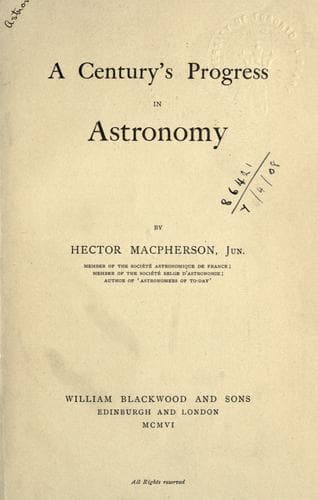
A Century's Progress in AstronomyMacpherson, Hector
History
A Century's Progress in Astronomy
Macpherson, Hector
Astronomy -- History
The foundation of variable-star astronomy as an exact branch of the
science is due to Argelander. In the years 1837-1845, while residing at
Bonn during the erection of the observatory, of which he had been made
director, he erected a temporary observatory, and there he carefully
determined the magnitudes of all stars visible in Central Europe. From
this he was led to the discussion of stellar variation, to which subject
he continued to give much attention. He was the first to describe a
method of observing variable stars scientifically and accurately,—a
method consisting in estimating in “steps” or “grades” the difference in
brilliance between the variable, or suspected variable, and other stars
which are selected for comparison, and which are of various degrees of
brilliance, so that they may be available for comparison with the
variable throughout its fluctuations. Argelander’s “steps” are tenths of
a magnitude, and Gore describes the method of observation as follows:
“If we call _a_ and _b_ the comparison stars, and _v_ the variable, _a_
being brighter than _b_, and if _v_ is judged to be midway in brightness
between _a_ and _b_, we write _a_5_v_5_b_. If _v_ is slightly nearer to
_b_, we write _a_6_v_4_b_. We may also write _a_3_v_7_b_, or
_a_7_v_3_b_, the sum of the steps being always ten.”
This method, described in 1844, led to many discoveries at Bonn in the
following twenty years by Argelander and his assistants Schmidt and
Schönfeld. At this time Eduard Heis (1806-1877), at Münster, who also
ranks as one of the founders of meteoric astronomy, while engaged on the
construction of his great atlas, attentively determined the change of
magnitude of stars visible to the naked eye; and by means of the naked
eye, the opera-glass, and a small telescope, he amassed a large number
of observations. At the same time two English observers, Hind and
Pogson, were making remarkable discoveries which greatly increased the
number of known variables. Among Hind’s discoveries were S Cancri of the
Algol type; while Schmidt discovered another of the same class, δ Libræ,
and also the famous ζ Geminorum. While director of the Observatory of
Mannheim, an institution equipped with very antiquated instruments,
Schönfeld devoted himself to the study of variable stars, and increased
the number of known variables considerably. In the southern hemisphere
Gould, in South America, did for the observation of variable stars what
Argelander did in the northern.
Public-domain text, read in full here on John Shaqi.
Reviews
Reviews
No reviews yet
Be the first to share your thoughts on this work.
Elsewhere in the archive
Join the Discussion
Join the discussion
Sign in to leave a comment or review.
Sign InorCreate an account