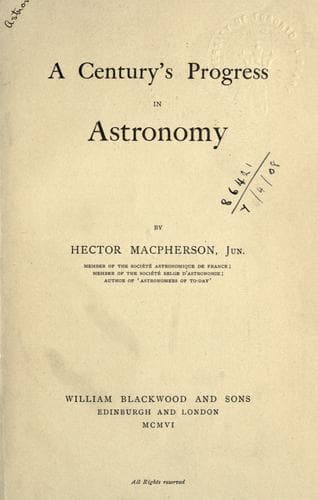
A Century's Progress in AstronomyMacpherson, Hector
History
A Century's Progress in Astronomy
Macpherson, Hector
Astronomy -- History
A temporary star, appropriately designated “the new star of the new
century,” blazed out in Perseus on the night of February 21, 1901. It
was discovered independently by several observers: on February 21, by
Borisiak, a student at Kiev, in Russia; on the following morning, by
Anderson in Edinburgh; and on the next evening, by Gore at Dublin,
Nordvig in Denmark, Grimmler at Erlangen, and other observers. When
first seen by Anderson, it was equal to Algol, of the second magnitude.
A photograph by Williams at Brighton showed that it must have been
fainter than the twelfth magnitude on February 20. On the evening of
February 23 the star was brighter than Capella, and was then the
brightest star in the northern hemisphere. On February 25 it fell to the
first magnitude; on March 1 to the second, and on March 6 to the third.
During the spring and summer the light fluctuated considerably, but in
September and October faded to the 6·7 magnitude. In March 1902 it was
of the eighth magnitude, and in July 1903 of the twelfth.
The spectrum of Nova Persei was found by Pickering to be of the Orion
type on February 22 and 23. On February 24 the spectrum had become one
of the bright and dark lines, and the hydrogen lines indicated a
velocity of 700 to 1000 miles a second. Measures of the sodium and
calcium lines, by Campbell and others, indicated a velocity of only
three miles a second, so that the displacements of the hydrogen lines
may have been due to an outburst of hydrogen in the star. The spectrum
was carefully studied during the spring and summer by Pickering,
Lockyer, Huggins, Vogel, and others. On June 25 Pickering reported that
the spectrum was slowly changing into that of a gaseous nebula. In
August and September 1901 the nebular spectrum became more apparent.
In August 1901 Wolf at Heidelberg discovered a faint trace of nebula
near the nova. On September 20 this nebula was photographed by _George
Ritchey_ at the Yerkes Observatory, and was seen to be of a spiral form.
This was confirmed by Perrine, who also found, from plates taken in
November, that the nebula was moving at the rate of eleven minutes of
arc a year. This extraordinary velocity was exceedingly puzzling to
astronomers, and at length Kapteyn suggested that the nebula shone only
by reflected light from the new star, and that the apparent motion was
an illusion caused by the flare of the explosion travelling out from the
nova.
On March 16, 1903, _Herbert Hall Turner_ (born 1861), Professor of
Astronomy at Oxford, discovered a new star of the seventh magnitude in
the constellation Gemini, from an examination of photographic plates.
Photographs taken at Harvard showed that on March 1 it must have been
fainter than the twelfth magnitude, while five days later it was of the
fifth. In August 1903 Pickering found its spectrum nebular. In August
1905 another small nova was found by Mrs Fleming on the Harvard
photographs, situated in Aquila.
Public-domain text, read in full here on John Shaqi.
Reviews
Reviews
No reviews yet
Be the first to share your thoughts on this work.
Elsewhere in the archive
Join the Discussion
Join the discussion
Sign in to leave a comment or review.
Sign InorCreate an account