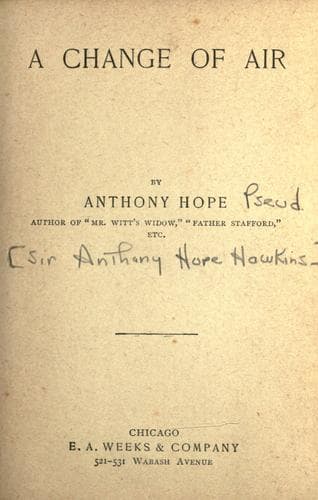
Country homes -- Fiction; England -- Social life and customs -- 19th century -- Fiction; Fame -- Fiction; Poets -- Fiction
"I will awake the world," Dale Bannister had once declared in the
insolence of youth and talent and the privacy of a gathering of
friends. The boast was perhaps as little absurd in his mouth as it
could ever be; yet it was very absurd, for the world sleeps hard, and
habit has taught it to slumber peacefully through the batterings of
impatient genius at its door. At the most, it turns uneasily on its
side, and, with a curse at the meddlesome fellow, snores again. So Dale
Bannister did not awake the world. But, within a month of his coming
to Littlehill, he performed an exploit which was, though on a smaller
scale, hardly less remarkable. He electrified Market Denborough,
and the shock penetrated far out into the surrounding districts of
Denshire--even Denshire, which, remote from villas and season-tickets,
had almost preserved pristine simplicity. Men spoke with low-voiced awe
and appreciative twinkling of the eye of the "doings" at Littlehill:
their wives thought that they might be better employed; and their
children hung about the gates to watch the young man and his guests
come out. There was disappointment when no one came to church from
Littlehill; yet there would have been disappointment if anyone had:
it would have jarred with the fast-growing popular conception of the
household. To the strictness of Denborough morality, by which no sin
was leniently judged save drunkenness, Littlehill seemed a den of
jovial wickedness, and its inhabitants to reck nothing of censure,
human or divine.
As might be expected by all who knew him, the Mayor had no hand in
this hasty and uncharitable judgment. London was no strange land to
him; he went up four times a year to buy his stock; London ways were
not Denshire ways, he admitted, but, for all that, they were not to be
condemned offhand nor interpreted in the worst light without some pause
for better knowledge.
"It takes all sorts to make a world," said he, as he drank his
afternoon draught at the "Delane Arms," where the civic aristocracy was
wont to gather.
"He's free enough and to spare with 'is money," said Alderman
Johnstone, with satisfaction.
"You ought to know, Johnstone," remarked the Mayor significantly.
"Well, I didn't see no 'arm in him," said Mr. Maggs, the horse-dealer,
a rubicund man of pleasant aspect; "and he's a rare 'un to deal with."
Interest centered on Mr. Maggs. Apparently he had spoken with Dale
Bannister.
"He's half crazy, o' course," continued that gentleman, "but as
pleasant-spoken, 'earty a young gent as I've seen."
"Is he crazy?" asked the girl behind the bar.
"Well, what do you say? He came down a day or two ago, 'e and 'is
friend, Mr. 'Ume----"
"Hume," said the Mayor, with emphasis. The Mayor, while occasionally
following the worse, saw the better way.
Public-domain text, read in full here on John Shaqi.
Reviews
Reviews
No reviews yet
Be the first to share your thoughts on this work.
Join the Discussion
Join the discussion
Sign in to leave a comment or review.
Sign InorCreate an account