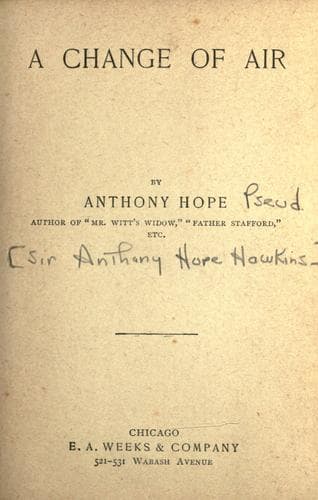
Country homes -- Fiction; England -- Social life and customs -- 19th century -- Fiction; Fame -- Fiction; Poets -- Fiction
If men never told their wives anything, the condition of society would
no doubt be profoundly modified, though it is not easy to forecast the
precise changes. If a guess may be hazarded, it is probable that much
less good would be done, and some less evil said: the loss of matter
of interest for half the world may be allowed to sway the balance in
favor of the present practice--a practice so universal that Mr. Delane,
the Mayor, and Alderman Johnstone, one and all, followed it by telling
their wives about their Sunday afternoon at Littlehill. Dr. Roberts,
it is true, gave a meager account to his wife, but the narratives of
the other three amply filled the gaps he left, and, as each of them
naturally dwelt on the most remarkable features of their entertainment,
it may be supposed that the general impression produced in Market
Denborough did not fall short of the truth in vividness of color.
The facts as to what occurred have been set down without extenuation
and without malice: the province of Market Denborough society was to
supply the inferences arising therefrom, and this task it fulfilled
with no grudging hand. Before eight-and-forty hours had passed, there
were reports that the Squire had discovered a full-blown Saturnalia in
process at Littlehill--and that in these scandalous proceedings the
Mayor, Alderman Johnstone, and Dr. Roberts were participators.
Then ensued conduct on the part of the Mayor and the Alderman deserving
of unmeasured scorn. They could not deny that dreadful things had been
done and said, though they had not seen the deeds nor understood the
words: their denial would have had no chance of credit. They could not
venture to say that Squire Delane had done anything except manfully
protest. They began by accusing one another in round terms, but each
found himself so vulnerable that by an unholy tacit compact they
agreed to exonerate one another. The Mayor allowed that Johnstone was
not conspicuous in wickedness; Johnstone admitted that the Mayor had
erred, if at all, only through weakness and good-nature. Public opinion
demanded a sacrifice; and the Doctor was left to satisfy it. Everybody
was of one mind in holding that Dr. Roberts had disgraced himself, and
nobody was surprised to hear that the Squire's phaeton had been seen
standing at his door for half an hour on Wednesday morning. The Squire
was within, and was understood to be giving the Doctor a piece of his
mind.
The Doctor was stiff-necked.
"It is entirely a private matter," said he, "and no one has a right to
dictate to me."
"My dear Roberts, I spoke merely in your own interest. It would ruin
you if it became known that you held those atrocious opinions; and
become known it must, if you openly ally yourself with this young man."
"I am not the servant of the people I attend. I may choose my own
opinions."
"Yes, and they may choose their own doctor," retorted the Squire.
Public-domain text, read in full here on John Shaqi.
Reviews
Reviews
No reviews yet
Be the first to share your thoughts on this work.
Join the Discussion
Join the discussion
Sign in to leave a comment or review.
Sign InorCreate an account