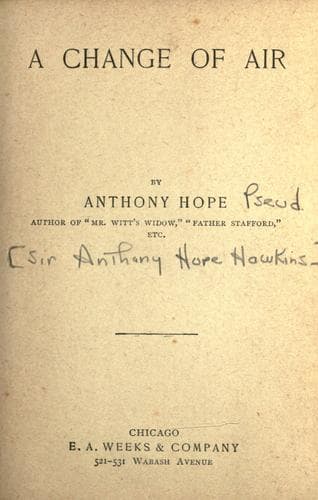
Country homes -- Fiction; England -- Social life and customs -- 19th century -- Fiction; Fame -- Fiction; Poets -- Fiction
"She thinks quite enough about him already, and hears enough, too."
"Well, I suppose he's something out of the common run, in Denshire at
all events, and so he interests her."
"She'll have nothing to say to Gerard Ripley."
"What? Has he asked her?"
"No; but I found out from her. He's quite indifferent to her."
"I'm sorry for that, but there's time yet. I don't give up hope."
"Do you think you help your wishes by asking her to use her influence
to make Dale Bannister write poems?"
The Squire laid down his napkin and looked at his wife.
"Oh!" he said, after a pause.
"Yes," said Mrs. Delane. "Are you surprised?"
"Yes, I am, rather."
He got up and walked about the room, jangling the money in his pocket.
"We know nothing about young Bannister," he said.
"Except that he's the son of a Dissenting minister and has lived with
very queer people."
The Squire frowned; but presently his face cleared. "I dare say we're
troubling ourselves quite unnecessarily. I haven't noticed anything."
"I dare say not, George," said Mrs. Delane.
"Come, Mary, you know it's a weakness of yours to find out people's
love affairs before they do themselves."
"Very well, George," answered she in a resigned tone. "I have told
you, and you will act as you think best. Only, if you wouldn't like him
for a son-in-law----"
"Well, my dear, you do go ahead."
"Try to put him out of Janet's head, not in it;" and Mrs. Delane swept
out of the room.
The Squire went to his study, thinking as he went. He would have
liked the Ripley connection. Lord Cransford was an old friend, and
the match would have been unimpeachable. Still---- The Squire could
not quite analyze his feelings, but he did feel that the idea of Dale
Bannister was not altogether unattractive. By birth, of course, he
was a nobody, and he had done and said, or at least said he had done,
or would like to do,--for the Squire on reflection softened down his
condemnation,--wild things; but he was a distinguished man, a man of
brains, a force in the country. One must move with the times. Nowadays
brains opened every front door, and genius was a passport everywhere.
He was not sure that he disliked the idea. Women were such sticklers
for old notions. Now, he had never been a--stick-in-the-mud Tory. If
Dale went on improving as he was doing, the Squire would think twice
before he refused him. But there! very likely it was only Mary's
match-making instincts making a mountain out of a molehill.
"I shall keep at Jan about that poem," he ended by saying. "It would be
a fine facer for the Radicals."
CHAPTER XV.
=How It Seemed to the Doctor.=
Public-domain text, read in full here on John Shaqi.
Reviews
Reviews
No reviews yet
Be the first to share your thoughts on this work.
Elsewhere in the archive
Join the Discussion
Join the discussion
Sign in to leave a comment or review.
Sign InorCreate an account