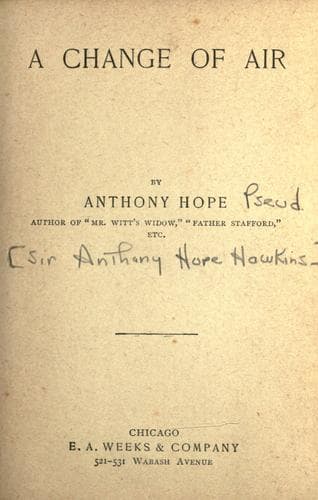
Country homes -- Fiction; England -- Social life and customs -- 19th century -- Fiction; Fame -- Fiction; Poets -- Fiction
James Roberts made to himself some excuse of business for his sudden
expedition to London, but in reality he was moved to go by the desire
for sympathy. There are times and moods when a man will do many strange
things, if thereby he may gain the comfort of an approving voice. It
was not so much his straitened means and impoverished household, with
the silent suppressed reproach of his wife's sad face, which made
Denborough for the time uninhabitable to the Doctor. The selfishness
engendered by his absorption in outside affairs armed him against
these; he was more oppressed, and finally overcome and routed to
flight, by the universal, unbroken, and unhesitating condemnation
and contempt that he met with. The severe banned him as wicked, the
charitable dubbed him crazy; even Johnstone, whom he had bought, gave
him no sympathy. He could not share his savage sneers, or his bitter
mirth, or his passionate indignation, with a man to whom the whole
affair was a matter of business or of personal grudge. He felt that he
must escape for a time, and seek society in which he could unbosom
himself and speak from his heart without stirring horror or ridicule.
Arthur Angell at least, who, in regard to Dale and Dale's views, had
always been a better royalist than the King, would share his anger
and appreciate his meditated revenge. The lesson he meant to give the
backslider was so appropriate and of such grim humor that Arthur must
be delighted with it.
On Dale's departure, Arthur Angell had moved into the little flat at
the top of the tall building in Chelsea, and there he cultivated the
Muses with a devotion which was its own ample reward. Though to be
passing rich on forty pounds a year is, with the best will, impossible
in London as it is to-day, yet to be passing happy on one hundred
and fifty is not beyond the range of youth and enthusiasm, when the
future still provides a gorgeous setting and background, wherein the
sordid details of the present are merged and lose their prominence,
and all trials are but landmarks by which the hopeful grub counts his
nearer approach to butterflydom. The little room, the humble chop, the
occasional pit, the constant tobacco, the unending talks with fellows
like-minded and like-pursed--all these had the beauty of literary
tradition, and if not a guarantee, seemed at least a condition of
future fame. So Arthur often said to Mrs. Hodge, who lived in the same
block, a couple of floors lower down; and Mrs. Hodge heartily agreed as
she instanced, in confirmation of the doctrine, how the late Mr. Hodge
had once played the King at two pound ten, _consule Pratt_, and had
lived to manage his own theater. This was to compare small things with
great, felt Arthur, but the truth is true in whatever sphere it works.
Public-domain text, read in full here on John Shaqi.
Reviews
Reviews
No reviews yet
Be the first to share your thoughts on this work.
Elsewhere in the archive
Join the Discussion
Join the discussion
Sign in to leave a comment or review.
Sign InorCreate an account