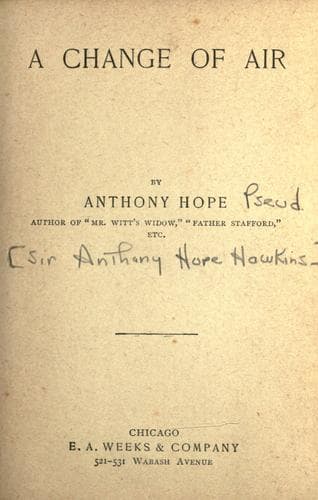
Country homes -- Fiction; England -- Social life and customs -- 19th century -- Fiction; Fame -- Fiction; Poets -- Fiction
As he walked, he bought the special edition of the paper, and, in
hastily glancing at it, his eye was caught by the announcement that
His Royal Highness the Duke of Mercia was to visit Lord Cransford,
and would open the Institute at Market Denborough. The paragraph went
on to describe the preparations being made to give the Prince a loyal
reception, and ended by saying that it was hoped that the eminent poet,
Mr. Dale Bannister, who was resident at Denborough, would consent to
write a few lines of welcome to the illustrious visitor. The writer
added a word or two of good-natured banter about Mr. Bannister's
appearance in a new character, and the well-known effect which the
proximity of royalty was apt to have on English republicanism. "Who
knows," he concluded, "that Mr. Bannister may not figure as Sir Dale
before long?"
The Doctor read the paragraph twice, the flush of anger reddening
his pale face. Then he crumpled up the paper and flung it from him,
resuming his hasty, restless walk. He could imagine the sickening
scene, the rampant adulation, the blatant snobbishness. And, in the
midst, a dishonored participator, the man who had been his leader,
his liberator, the apostle of all he loved and lived by. Had the man
been a hypocrite from the first? Impossible! No hypocrite could have
written those burning lines which leaped to his memory and his lips. Or
was he merely a weak fool? That could not be either. It was a barter,
a deliberate barter of truth and honor against profit--as sordid a
transaction as could be. He wanted a position in society, money, a rich
wife, petting from great people--perhaps even, as that scribbler said,
a ribbon to stick in his coat or a handle to fasten to his name. How
could he? how could he? And the Doctor passed his hand across his hot,
throbbing brow in the bewilderment of wrath.
For an hour and more he ranged the streets aimlessly, a prey to his
unreasoning fury. For this man's sake he had ruined himself; led on by
this man's words, he had defied the world--his world. At all hazards
he had joined the daring band. Now he was forsaken, abandoned, flung
aside. He and his like had served their turn. On their backs Dale
Bannister had mounted. But now he had done with them, and their lot was
repudiation and disdain. Roberts could not find words for his scorn and
contempt. His head racked him more and more. Connected thought seemed
to become impossible; he could do nothing but repeat again and again,
"The traitor! The traitor!"
At last he turned home to his humble lodgings. The short hush of very
early morning had fallen on the streets; he met no one, and the moon
shone placidly down on the solitary figure of the maddened man,
wrestling with his unconquerable rage. He could not stem it; yielding
to its impulse, with quivering voice and face working with passion, he
stretched his clenched fist to the sky and cried:
"By God, he shall pay for it!"
CHAPTER XVI.
="No More Kings."=
Public-domain text, read in full here on John Shaqi.
Reviews
Reviews
No reviews yet
Be the first to share your thoughts on this work.
Elsewhere in the archive
Join the Discussion
Join the discussion
Sign in to leave a comment or review.
Sign InorCreate an account