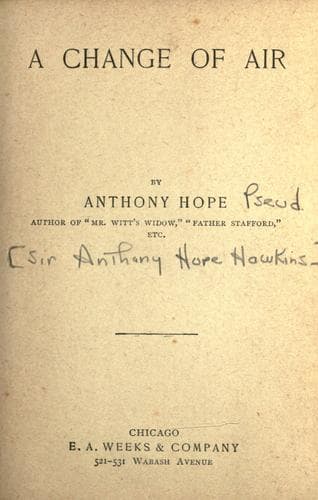
Country homes -- Fiction; England -- Social life and customs -- 19th century -- Fiction; Fame -- Fiction; Poets -- Fiction
After her father's report and the departure of Nellie Fane, Miss Tora
Smith had been pleased to reconsider her judgment of Dale Bannister,
and to modify it to some extent. The poems and the suspicion, taken in
conjunction, each casting a lurid light on the other, had been very bad
indeed; but when Tora's mind was disabused of the suspicion, she found
it in her heart to pardon the poems. Although she treated Sir Harry
Fulmer with scant ceremony, she had no small respect for his opinion,
and when he and the Colonel coincided in the decision that Dale need
not be ostracized, she did not persist against them. She was led to be
more compliant by the fact that she was organizing an important Liberal
gathering, and had conceived the ambition of inducing Dale to take part
in the proceedings.
"Fancy, if he would write us a song!" she said; "a song which we could
sing in chorus. Wouldn't it be splendid?"
"What would the Squire say?" asked Sir Harry.
Tora smiled mischievously.
"Are you," she demanded, "going to stand by and see him captured by the
Grange?"
"He ought to be with us, oughtn't he?" said Sir Harry.
"Of course. And if our leader had an ounce of zeal----"
"I'll write to him to-day," said Sir Harry.
"Yes; and mind you persuade him. I shall be so amused to see what Jan
Delane says, if he writes us a song."
"He won't do it."
"He won't, if you go in that despairing mood. Now write at once. Write
as if you expected it."
The outcome of this conversation, together with the idea which
had struck the Squire, was, of course, that Dale received, almost
by the same post, an urgent request for a militant Radical ditty,
and a delicate, but very flattering, suggestion that it would be
most agreeable to His Royal Highness--indeed he had hinted as much
in response to Lord Cransford's question--to find the loyalty of
Denborough, as it were, crystallized in one of Mr. Bannister's undying
productions. For the first time in his life, Dale felt a grudge against
the Muses for their endowment. Could not these people let him alone? He
did not desire to put himself forward; he only asked to be let alone.
It was almost as repugnant to him--at least, he thought it would be--to
take part in Lord Cransford's pageant, as it certainly would be to hear
the Radicals of Denborough screeching out his verses. He was a man of
letters, not a politician, and he thought both requests very uncalled
for. It might be that the Grange folks had some claim on him, but his
acquaintance with Sir Harry Fulmer was of the slightest; and what did
the man mean by talking of his "well-known views"? He was as bad as the
Doctor himself. Presently Philip Hume came in, and Dale disclosed his
perplexities.
"I want to please people," he said, "but this is rather strong."
"Write both," suggested Philip.
"That will enrage both of them."
"Then write neither."
"Really, Phil, you might show some interest in the matter."
"I am preoccupied. Have you been in the town to-day, Dale?"
"No."
Public-domain text, read in full here on John Shaqi.
Reviews
Reviews
No reviews yet
Be the first to share your thoughts on this work.
Elsewhere in the archive
Join the Discussion
Join the discussion
Sign in to leave a comment or review.
Sign InorCreate an account