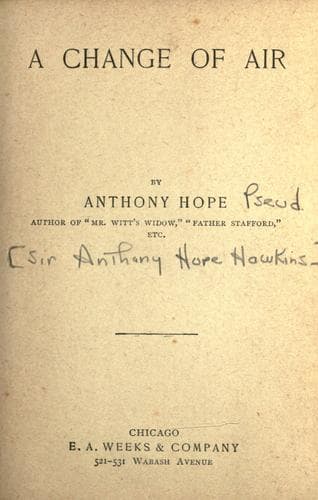
Country homes -- Fiction; England -- Social life and customs -- 19th century -- Fiction; Fame -- Fiction; Poets -- Fiction
"What's the meaning of this?" gasped the Doctor, and as he spoke the
glass door which led to the parlor opened a little way.
"It means, Doctor, that I've had enough of it."
"Enough of it?"
"Yes. Mr. Bannister aint done me any 'arm, and I'm not going to fret
him any more."
"You scoundrel!" shrieked the maddened man; "you thief! you took my
money--you----"
"There's your books, and there in the envelope you'll find your 'undred
pound. Take 'em and get out."
"So Bannister has been at you?" sneered Roberts.
"I aint seen 'im."
"Ah!"
He was quiet now, the cold fit was on him. He took no notice of the
books, but put the envelope in his pocket and turned to go, saying:
"You think you can stop my revenge, you pitiful fool; you'll see."
Johnstone gave himself a shake.
"I'm well out of that," he said. "I b'lieve he's crazy. Sally, where
are you?"
Sally came, and no doubt the Alderman gained the reward of the
righteous, in whose house there is peace.
When the Squire received an acceptance of his invitation from
Alderman and Mrs. Johnstone, he became more than ever convinced that
every Radical was at heart a snob. Perhaps it would have been fair
to remember that most of them are husbands. Be that as it may, his
scheme had worked. The posters, the books, and the sandwich-men were
gone. There was nothing now to remind Denborough that it harbored a
revolutionist. What was more important still, there was nothing to
remind Dale Bannister of the indiscretions of his past. He might now
read his ode, unblushing, in High Street, and no placard would scream
in ill-omened reminder: "No more Kings!"
CHAPTER XIX.
=A Well-Paid Poem.=
Among the quieter satisfactions of life must be ranked in a high place
the peace of a man who has made up his mind. He is no longer weighing
perplexing possibilities, but, having chosen his path, feels that he
has done all that can be done, and that this conviction will enable him
to bear with patience the outcome of his determination, whatever it may
be. Of course he is wrong, and if misfortune comes, his philosophy will
go to the wall, but for the moment it seems as if fate cannot harm him,
because he has set his course and bidden defiance to it.
Public-domain text, read in full here on John Shaqi.
Reviews
Reviews
No reviews yet
Be the first to share your thoughts on this work.
Elsewhere in the archive
Join the Discussion
Join the discussion
Sign in to leave a comment or review.
Sign InorCreate an account