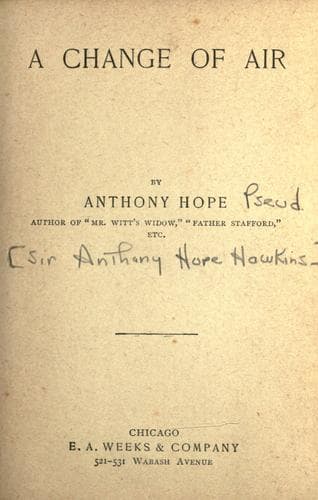
Country homes -- Fiction; England -- Social life and customs -- 19th century -- Fiction; Fame -- Fiction; Poets -- Fiction
There are not many of us who would feel warranted in being very hard on
a man who had failed in such a trial as had befallen Janet Delane: in
a woman, failure would seem little other than a necessary consequence
of her sex. Death, sudden, violent, and horrible, searches the heart
too closely for anyone to feel sure that his would be found sound to
the core--not risk of death, for that most men will, on good cause and,
even more cheerfully, in good company, meet and face. It is certainty
that appalls; and it had been certain death that had awaited Janet's
first cry. And yet she would not be comforted. She had stopped to
think how certain it was; then she failed. The mistake was in stopping
to think at all. The other girl--the girl he did not love, but who,
surely, loved him with a love that was love indeed--had not stopped
to think whether the bullet could or might or must hit her. She had
not cared which; it had been enough for her that it might hit the man
she loved, unless she stood between to stop it, and she had stood
between. How could Janet excuse her cowardice by telling herself of the
certainty of death, when, had she not been a coward, she would never
have stayed to know whether death were certain or not? If she ever
could have deluded herself like that, what the other girl did made it
impossible. The other girl--so she always thought of Nellie--held up
a mirror wherein Janet saw her own littleness. And yet he had loved
her, not the other; her life belonged to him, the other's did not;
she had proclaimed proudly, but an instant before, that she would die
for him, and he had praised her for saying it. He would know now what
her protestations were worth. He would be amused to think that it was
not Janet Delane--the Janet who was always exhorting him to noble
thoughts--who was proud in the pride of her race--not she who had dared
death for him; but that other, so far beneath her, whom she had not
deigned to think a rival. Ah, but why, why had she not called? Surely
God would have given her one moment to be glad in, and that would have
been enough.
Public-domain text, read in full here on John Shaqi.
Reviews
Reviews
No reviews yet
Be the first to share your thoughts on this work.
Elsewhere in the archive
Join the Discussion
Join the discussion
Sign in to leave a comment or review.
Sign InorCreate an account