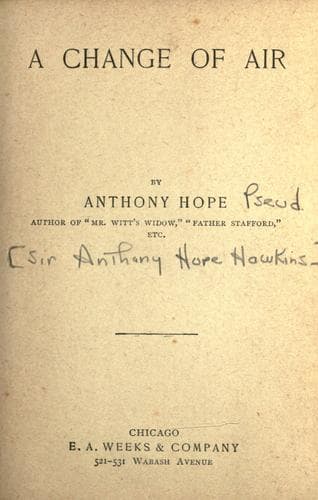
Country homes -- Fiction; England -- Social life and customs -- 19th century -- Fiction; Fame -- Fiction; Poets -- Fiction
"She must be a little queer still," said the Squire, with anxiety.
"Don't be worried, Mary. She's a strong girl, and she'll soon throw it
off."
But she could not throw it off--not that thought which had burned into
her breast; and all night, by the light of the moon, she sat and looked
at the tree and the fresh gravel, the spot where her honor and her love
had called on her, and called in vain.
CHAPTER XXII.
=The Fitness of Things.=
If anything could have consoled Market Denborough for the certain
postponement and possible loss of the Duke of Mercia's visit, it
would have been the cause of these calamities. Its citizens were not
more hard-hearted than other people, and they bestowed much sympathy
on Nellie Fane, who, out of the competitors, was easily elected the
heroine of the incident; but neither were they more impervious to the
charms of excitement, of gossip, and of notoriety. The reporters and
the artists who had been told off to describe and depict the scene
of the royal visit did not abandon their journey, but substituted
sketches of the fatal spot, of the Grange, of Littlehill, and of the
actors in the tragedy; while interviews with the Mayor, and anybody
else who knew, or knew someone who knew about the circumstances, or
professed to do either, amply supplied the place which the pageant and
the speeches had been destined to fill. And if the occurrence excited
such interest in the great London papers, the broadsheets and columns
of the local journals were a sight to behold. The circulation of the
_Standard_ went up by more than a hundred; while the _Chronicle_
announced, it must be admitted to a somewhat skeptical world, that
its weekly issue had exhausted three editions, and could no longer be
obtained at the booksellers' or the office. The assertion, however,
being untested, passed, and everyone allowed that young Mingley's
detailed account of poor Roberts' last words to Dale Bannister,
before he fired, were perfect in verisimilitude, which, under the
regrettable circumstance of Mingley's absence, and of no such words
having been uttered, was all that could be expected. Mingley was puffed
up, demanded a rise of salary, got it, and married Polly Shipwright,
the young lady at the "Delane Arms." So the ill wind blew Mingley
good. Yet the editor of the _Chronicle_ was not satisfied, and as
a further result of Mingley's activity, he inserted an article the
following week, in which he referred, with some parade of mystery,
to the romantic character of the affair. It was not only in fiction,
he remarked, that love had opportunities for displaying itself in
heroism, nor, it was to be earnestly hoped, only in the brains of
imaginative writers that affection and gratitude found themselves
working together toward a joyful consummation. Denborough knew and
admired its gifted fellow-townsman, and Denborough had been a witness
of the grace and charm of the young lady who had shed such luster
on her sex.
Public-domain text, read in full here on John Shaqi.
Reviews
Reviews
No reviews yet
Be the first to share your thoughts on this work.
Elsewhere in the archive
Join the Discussion
Join the discussion
Sign in to leave a comment or review.
Sign InorCreate an account