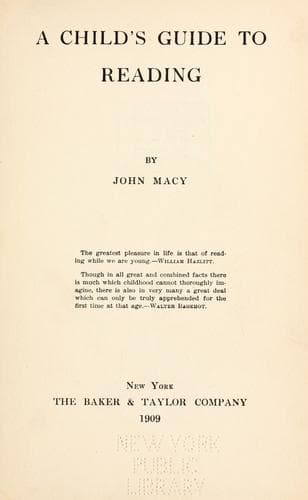
Books and reading; Children's literature -- Bibliography
I happen to be writing in Christmas week, and I have read for the tenth
time “A Christmas Carol,” by Dickens, that amazing allegory in which
the hard, bitter facts of life are involved in a beautiful myth, that
wizard’s caldron in which humor bubbles and from which rise phantom
figures of religion and poetry. Can anyone doubt that if this story
were read by every man, woman, and child in the world, Christmas
would be a happier time and the feelings of the race elevated and
strengthened? The story has power enough to defeat armies, to make
revolutions in the faith of men, and turn the cold markets of the
world into festival scenes of charity. If you know any mean person,
you may be sure that he has not read “A Christmas Carol,” or that he
read it long ago and has forgotten it. I know there are persons who
pretend that the sentimentality of Dickens destroys their interest in
him. I once took a course with an overrefined, imperfectly educated
professor of literature, who advised me that in time I should outgrow
my liking for Dickens. It was only his way of recommending to me a kind
of fiction that I had not learned to like. In time I did learn to like
it, but I did not outgrow Dickens. A person who can read “A Christmas
Carol” aloud to the end and keep his voice steady is, I suspect, not a
safe person to trust with one’s purse or one’s honor.
It is not necessary to argue about the value of literature or even
to define it. One way of bringing ourselves to realize vividly what
literature can do for us is to enter the libraries of great men and see
what books have done for the acknowledged leaders of our race.
You will recall John Stuart Mill’s experience in reading Wordsworth.
Mill was a man of letters as well as a scientific economist and
philosopher, and we expect to find that men of letters have been
nourished on literature; reading must necessarily have been a large
part of their professional preparation. The examples of men of action
who have been molded and inspired by books will perhaps be more
helpful to remember; for most of us are not to be writers or to engage
in purely intellectual work; our ambitions point to a thousand
different careers in the world of action.
[Illustration: DICKENS]
Lincoln was not primarily a man of letters, although he wrote noble
prose on occasion, and the art of expression was important, perhaps
indispensable, in his political success. He read deeply in the law and
in books on public questions. For general literature he had little
time, either during his early struggles or after his public life began,
and his autobiographical memorandum contains the significant words:
“Education defective.” But these more significant words are found in a
letter which he wrote to Hackett, the player: “Some of Shakespeare’s
plays I have never read, while others I have gone over perhaps as
frequently as any unprofessional reader. Among the latter are ‘Lear,’
‘Richard III,’ ‘Henry VIII,’ ‘Hamlet,’ and, especially, ‘Macbeth.’”
Public-domain text, read in full here on John Shaqi.
Reviews
Reviews
No reviews yet
Be the first to share your thoughts on this work.
Join the Discussion
Join the discussion
Sign in to leave a comment or review.
Sign InorCreate an account